Skip to content

Annual Wastewater Report Released

Did you know that there is an annual report for wastewater?

If you answered “no” then here is all you need to know about the people who make sure your flush doesn’t become a mess.

When you flush, shower, or wash dishes, the wastewater flows from your plumbing to our public wastewater network of pipes. The wastewater then flows by gravity to one of our wastewater treatment plants so that it can be treated and safely discharged back into the creeks.
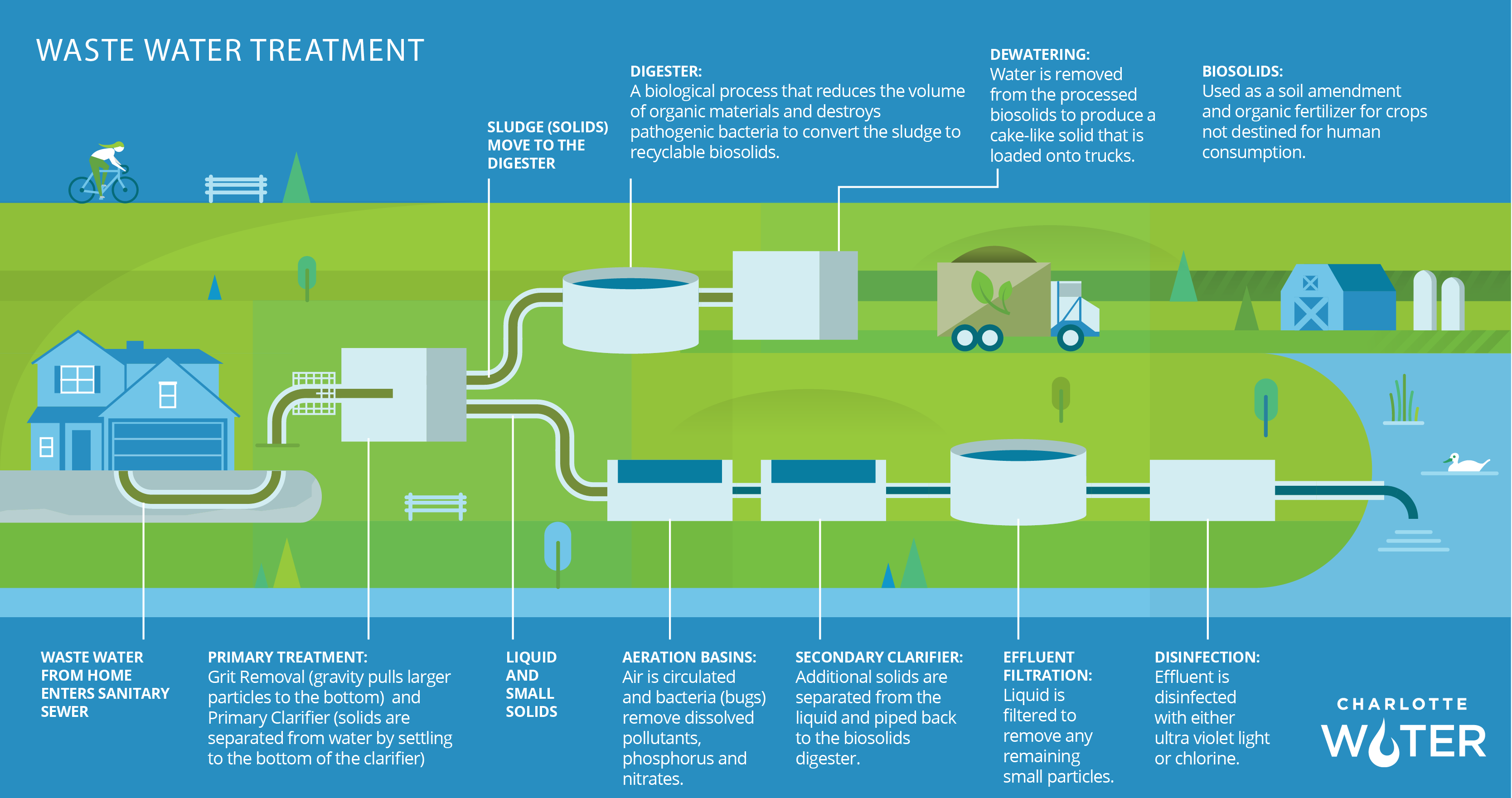
Diagram titled in white caps font Waste Water Treatment at top left describes the workflow of waste water treatment from residential home on its 10 step journey to the waterways. Landscape of the diagram is blue sky at the top, green space representing grass in the middle and the bottom depicts a water way connecting to a lake. All the structures described are using a graphic design of navy blue and light blue tones representing any body of water aspect, all pipes connecting everything are olive green. 1- residential home wit white caps font below it, Waste Water From Home Enters Sanitary Sewer; 2 - large gravity filter structure with tank is identified with white caps font as Primary Treatment: Grit Removal gravity pulls larger particles to the bottom and Primary Clarifier solids are separated from water by settling to the bottom of the clarifier; two green pipes leave that structure, one is item 3 - white caps font Sludge Solids move to the digester as identified by line pointing to green pipeline and the other is item 4 - white caps font Liquid and Small Solids point to another section of green pipe; from there material move through to two basins 5 - Aeration Basins: Air is circulated and bugs clean and move phosphorus and nitrates, the moving into item 6, Secondary Clarifier-Additional solids are separated from the liquid and piped back to the biosolids digester; from there the material follows the pipeline to item 7: Efficient Filtration in a round tank to filter out any small particles is followed by a trip to item 8: a tank for Disinfection with either UV or Chlorine and from there the pure water goes out to natural water source such as a lake. Now moving back to that second pipe routing to item 3; that material moves to item 9, a large round tank identified as a Digester- a bacterial process called digestion is used to reduce the amount of organic matter and the number of disease causing microorganisms; from that tank the material travels to a pipe to item 10, a building with a tank identified for Dewatering, the last bit of water is removed from the biosolids before it is loaded onto trucks where it will seek its final stop as Biosolids, used as a soil amendment and organic fertilizer for crops not used for human consumption. At very bottom right order of diagram is Charlotte Water logo in white font.

So how did we do?

Even as the population grows, Charlotte Water continues to reduce the number of wastewater spills.

See the following chart:
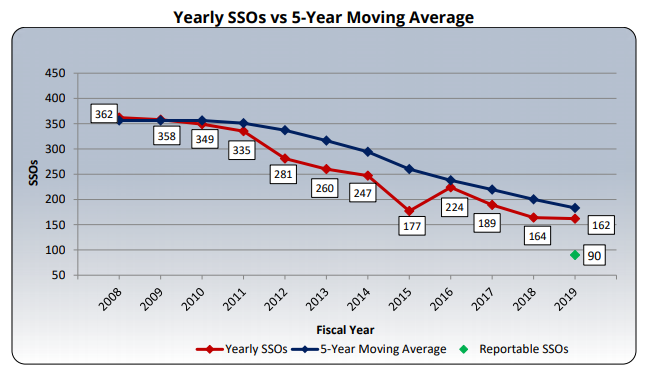
Graph with grey background titled with black font, Yearly SSOs vs 5 Year Moving Average. On the left increments of 50 from 50 to 450 and across the bottom, years indicated from 2008 to 2019. On the graph itself a blue and a red line both trending down. Legend at bottom indicated red as Yearly SSO and blue as 5 year moving average. A green diamond appears at lower right of graph at 100 meets 2019 and indicates Reportable SSOs

Charlotte Water successfully collected and treated 99.9 percent of the more than 33 billion gallons of wastewater that the community produced in the past fiscal year. Charlotte Water’s annual report includes all incidents where wastewater escaped out of a public manhole or public collection system pipe before reaching proper treatment and reportable spills, which are any spills that equal or exceed 1,000 gallons or more reaching creeks.

See the following chart:

Fiscal year 2018 2019 All spills 164 162 Reportable spills 107 90

How To Help:

Toss in the trash: paper towels, wipes, hair, cotton swabs, feminine products, dental floss, coffee grounds, and excess food.

Toss in the toilet: only toilet paper.

Kitchen sink: soap suds, small amounts of foods from plate, and liquids (no fats, oils, or grease).

Take to a full-service recycling center: used and expired oils and grease.

Suspect A Sewage Spill?
Call 311 or 704-336-7600. We respond 24 hours-a-day.
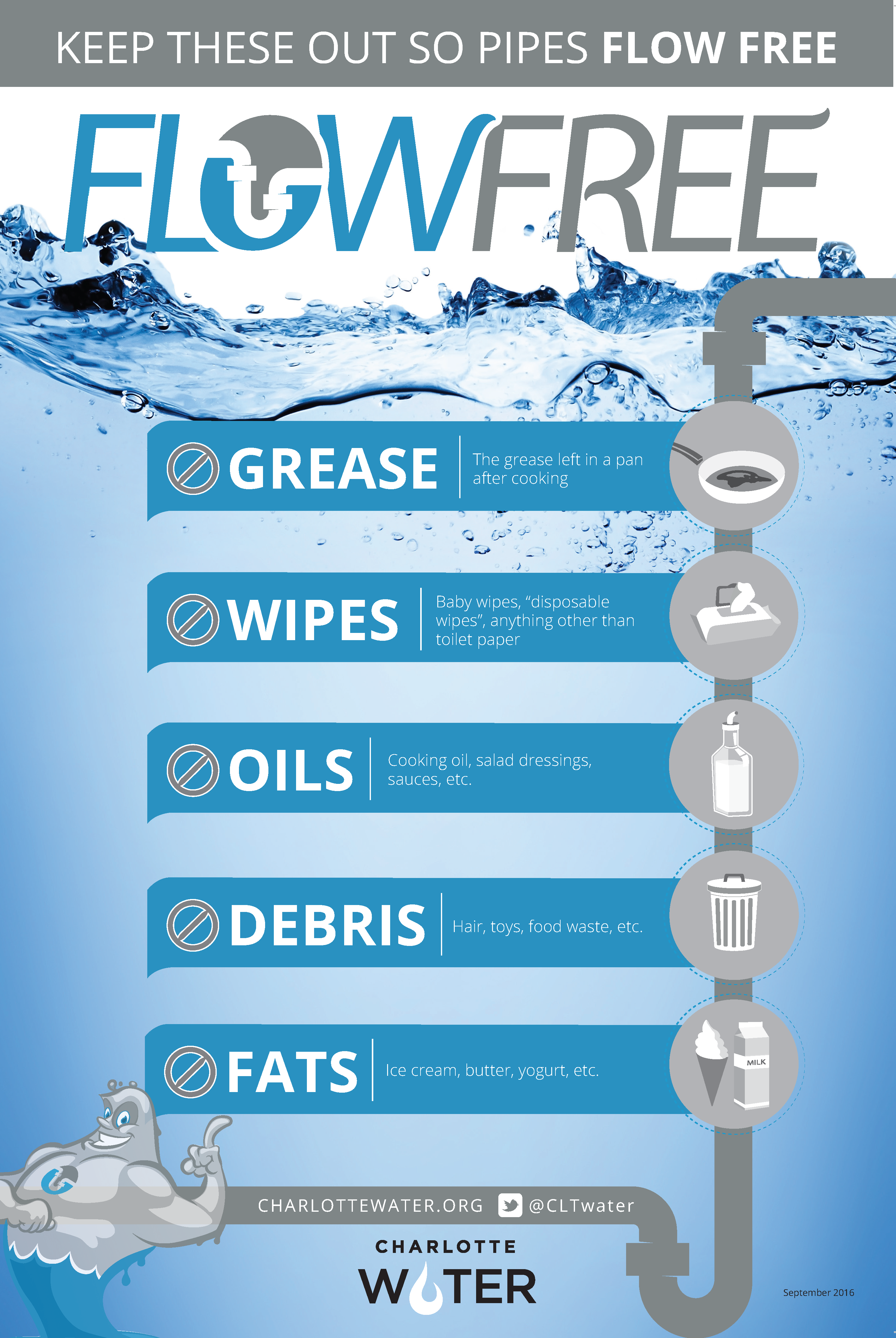
Poster with grey banner at top and white font caps lettering, Keep those out so pipes flow free. Below that is the FlowFree logo and the background of the poster is splashing blue water. Overlaid this image are 5 topics on darker blue rectangles each with a symbol in a grey circle. 5 topics in white font are, Grease, Wipes, Oils, Debris, Fats. Running vertically next to these 5 items is a graphic of a grey pipe that wraps around to the bottom of the poster where it intersects with the FLowFee mascot, a grey cartoon character that looks like a wave. At bottom of poster is the Charlotte Water logo in black font. Note, much of the copy on this poster is difficult to read due to font color selection

Links To Learn More:

Wastewater report

Videos about our excellent water professionals.

Discover more from Charlotte Water Blog

Subscribe now to keep reading and get access to the full archive.

Continue reading

document.addEventListener('DOMContentLoaded', function () { const observer = new MutationObserver(() => { document.querySelectorAll('.jetpack-instant-search__search-result-expanded__image').forEach(img => { if (!img.hasAttribute('alt')) { img.setAttribute('alt', ''); } }); }); observer.observe(document.body, { childList: true, subtree: true }); });