Category Archives: News

Neighbor Helping Neighbor: Charlotte Water Answers the Call

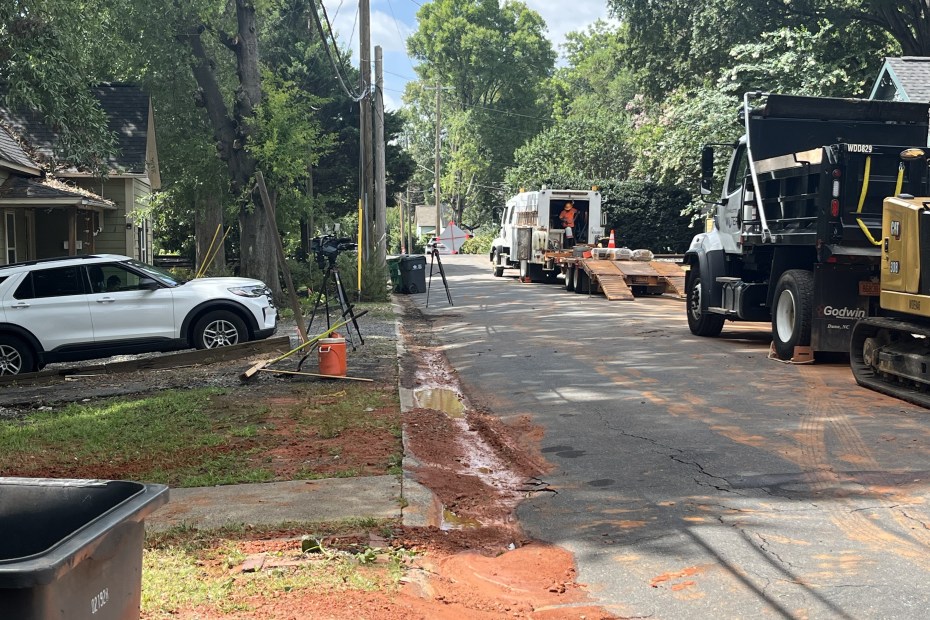
When emergencies impact water systems, utilities across North Carolina work together to help communities recover. That’s exactly what Charlotte Water is doing by providing assistance to Anson County as it continues recovery efforts following recent impacts to its water system.

Two Charlotte Water pickup trucks

As part of long-standing mutual aid partnerships, Charlotte Water has deployed crews to support Anson County with system flushing, an important step in restoring water quality. At the same time, water samples from Anson County are being analyzed at Charlotte Water’s state-certified laboratory, helping expedite the testing process and provide timely, accurate results.

Mutual aid agreements allow water utilities to share specialized personnel, equipment and technical expertise when emergencies occur. This collaboration helps affected communities recover more quickly while ensuring critical services continue uninterrupted.

Charlotte Water has the personnel and laboratory capacity to support Anson County while continuing to provide safe, reliable drinking water and wastewater services to our own customers. There is no impact to Charlotte Water operations or service levels.

“Helping neighboring communities during times of need is part of what we do,” said Charlotte Water Director Angela Charles. “Our mutual aid partnerships strengthen our region’s resilience and ensure utilities can support one another when unexpected challenges arise.”

Charlotte Water remains in close coordination with Anson County and regional utility partners throughout the recovery effort.

Residents seeking information about Anson County’s water system operations, boil water advisory, restoration timeline or other local response efforts should contact Anson County officials, who are leading the incident response.

At Charlotte Water, we’re proud to support our neighbors and demonstrate the strength of regional partnerships that help keep communities safe.

Say Goodbye to Slimy Mats: Lyngbya Treatment Underway at Lake Norman, Mountain Island & Lake Wylie

young man wearing blue windbreaker and grey ball cap sit in pilot's chair of a fan driven swamp boat on a lake
Lyngbya Treatment on Mountain Island Lake.

If you’ve spent any time around Lake Norman, Mountain Island Lake, or Lake Wylie in recent summers, you might’ve noticed thick, dark, musty-smelling mats floating near the shore. That fuzzy stuff? It’s not harmless lake gunk—it’s a type of algae called Lyngbya, and it’s been quietly spreading across southern reservoirs, turning once-clear waters into mucky messes.

But there’s good news on the horizon.

Starting this month and continuing through September, a coordinated effort is underway to treat Lyngbya in all three lakes. This initiative is led by the Catawba-Wateree Water Management Group, with help from county governments, marine commissions, North Carolina State University, and Duke Energy. The result? A much more streamlined and effective plan to tackle this invasive algae head-on.

What Exactly Is Lyngbya?

Lyngbya (recently reclassified as Microseria wollei) is a type of cyanobacteria—often called blue-green algae—that thrives in warm, nutrient-rich water. Unlike some seasonal algae, Lyngbya doesn’t go away when summer ends. It lives year-round on the lake bottom, then floats to the surface as water temperatures rise, forming dense mats that can clog boat motors, reduce water quality, and frankly, make lakes less enjoyable for everyone.

To give you a sense of how aggressive it can be: in 2024, Lake Gaston on the NC/VA border reported over 1,000 acres of Lyngbya infestation.

What’s Being Done?

For the 2025 season, treatment will cover 60 acres total across the three lakes:

  • 25 acres in Lake Norman
  • 25 acres in Mountain Island Lake
  • 10 acres in Lake Wylie

Monthly treatments will be handled by Aqua Services, Inc., using EPA-approved copper-based algaecides distributed by SePRO Corporation. If you live near the water, expect to see airboats cruising the shoreline mid-month, releasing a bright blue liquid into the water. That’s the algaecide at work—it may look dramatic, but it’s safe for fishing, swimming, and watering your plants.

Will It Work?

The short answer: yes, but it will take time.

Because Lyngbya is tough to kill and can look alive even when it’s not, results won’t be obvious overnight. You might see fewer surface mats this summer, but the real payoff will come after several treatment seasons. This approach mirrors the successful program at Lake Gaston, which is already seeing noticeable reductions in Lyngbya after multiple years of consistent treatment.

What Can You Do?

If you’re a lakefront property owner or just someone who loves spending weekends on the water, stay informed! You can report problem areas or learn more about aquatic vegetation management by emailing AquaticPlants@duke-energy.com or visiting duke-energy.com/AquaticPlants.


Bottom line: Lyngbya might be stubborn, but so are we. With consistent treatment and community awareness, our lakes can stay clean, healthy, and a joy to explore for years to come.

Got questions or curious about what you’re seeing in the water? Drop them in the comments—we’ll help you make sense of the science.

Additional Information:

2024 update about Lyngbya.

Microplastics Reduction Research at Charlotte Water.

Charlotte Water is Back in the Reclaimed Water Business!!!

Charlotte Water is once again providing reclaimed water to customers in the University Area, after a 10-year hiatus.  Charlotte Water’s Mallard Creek Water Resource Recovery Facility (WRRF ) produces high-quality reclaimed water that is distributed to permitted users, who use the water for irrigation and cooling tower water.  The reclaimed water system was constructed and placed into service in 1997 and provided permitted users with high quality reclaimed water until 2014.  When the Mallard Creek WRRF experienced an illicit discharge of PCB’s (Polychlorinated Biphenyls) in 2014, the Reclaimed Water System was shut down to protect permitted user’s systems from potential contamination.

Following the illicit PCB discharge to the Mallard Creek WRRF, the facility underwent a lengthy decontamination process in order to ensure the facility was free of PCBs.  After the decontamination process, the Mallard Creek WRRF was due for  Improvements and Capacity Expansion, due to the growth in the University Area. As the Improvements and Capacity Expansion were nearing completion, discussions with previous and potential new reclaimed water users began, and a timeline was set for the Reclaimed Water System to be re-activated.  The goal was to have the Reclaimed Water System back in service by the Summer of 2024.

The work to get the Reclaimed Water System back in service started in the early part of 2023.  Charlotte Water’s Environmental Management Division (EMD) started discussions throughout the department to plan for restarting the Reclaimed Water System after being dormant for 10 years.The various groups within Charlotte Water that came together for this effort included; Field Operations, Engineering, Water Treatment, Maintenance, Backflow, Customer Service, IT, and Laboratory Services.  This cross-functional team, with Leadership from Billy Allen (CLTWater’s Reclaimed Water System Coordinator), successfully conducted major required activities to get the system ready for operation once again.The major activities that needed to take place, included locating all valves and air release stations, exercising valves, testing backflow preventers, rebuilding air release stations, clearing right of ways, flushing of the reclaimed water pipelines with potable water, pressure testing the system with potable water, repairing two significant leaks, final flushing with reclaimed water, and sampling of the reclaimed water to ensure reclaimed water quality standards are being met.

Once the hard work from this cross-functional team was complete, Charlotte Water was ready to place the Reclaimed Water System back into service for the first time in 10 years.  On the morning of November 7th, a team from Charlotte Water’s EMD and Maintenance Divisions, completed the Switchover from Potable Water to Reclaimed Water, at The Tradition Golf Course, which Mecklenburg County owns.  CLTWater EMD and Maintenance Division Staff accompanied Pinnacle Golf Staff (the contract golf course operator for Mecklenburg County) onto the course, to observe them restarting their irrigation system on reclaimed water and were able to confirm the successful transition back to reclaimed water, by seeing reclaimed water applied to the green on hole 16.

Currently, the only user that is actively receiving Reclaimed Water is The Tradition Golf Course, however the University of North Carolina Charlotte (UNCC) hopes to begin receiving and utilizing reclaimed water sometime in 2025.  UNCC constructed a  reclaimed water pipeline on their campus in 2022.  CLTWater is also looking at ways to further expand the Reclaimed Water System in the University Area, as the use of reclaimed water offsets the use of potable water for irrigation and cooling tower water, as it reduces the impact on Charlotte Water’s Inter-Basin Transfer (IBT ) Certificate.

Many Charlotte Water Staff Members contributed greatly to this monumental effort, and everyone who participated should be extremely proud of this accomplishment!  The Restarting of the Reclaimed Water System could not have happened without your hard work and dedication.  A special recognition to the efforts of Rogers Brown, Corey Butler, Larry Davis, Don Rivers, and Shuhurah Lee, who all helped immensely with this effort in the field, during the past few months!

CLTWater Delivers Water Pressure During Massive Fire In SouthPark

On May 18th, Charlotte experienced one of the largest fires in the city’s history. Charlotte Water (CLTWater) responded with

  • Managers on location to assist with any water supply needs,
  • Operators pumped more water to the area,
  • Crews were on hand to assist if there were any water supply challenges.
  • Crews surveyed the area looking for and responding to water main breaks.
    • Water main breaks are likely after a massive flow of water is used for fighting fires.

Thank you to all that assisted in the response to ensure there was enough water supply and pressure for the Charlotte Fire Department (CFD) response.


“The partnership with the Charlotte Fire Department started more than 100 years ago and it is a weekly and sometimes daily coordination that enables us to assist in this crucial public safety role,”,” said Angela Charles, Director of Charlotte Water. “The investment in our water infrastructure has been instrumental in maintaining water supply and water pressure to serve our growing community and public safety needs.”

Charlotte Water Director Angela Charles coordinating with the Charlotte Fire Department during the fire.