Activity: Educational article about the journey of our water and its treatment process.
Age range: All ages

Our water goes on quite a journey from the Catawba River, through our treatment processes, up to our water towers, into your homes and businesses and back out again. In this lesson, we will provide you with some step-by-step insight into the full cycle of our water.
Step 1: Pumping the Water
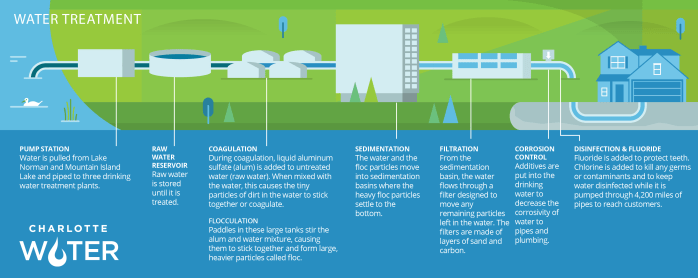
Our Pump stations are located at Lake Norman and Mountain Island Lake. Raw water is pulled from the lakes and pumped to our three treatment plants – Lee S. Dukes Water Treatment Plant, Franklin Water Treatment Plant, and Vest Water Treatment Plant. This water is pumped at night when the cost of electricity is low. Water from Lake Normal flows by gravity to the Lee S. Duke Water Treatment Plant.
Step 2: Water Treatment
When the water arrives at the water treatments plants, it is cleaned through coagulation, flocculation, sedimentation, and filtration. An average of 108 million gallons of water is pumped at our water treatment facilities each day. After we treat the water, it is distributed to businesses, factories, schools, and your home!
The Water Treatment Process
Transcript of this video appears at the bottom of this page.
Step 3: Water Tower Storage
Once water has been treated at one of treatment plants, some of that water is pumped to a nearby water tower for storage and later distribution. Water towers also serve the purpose of pressurizing the distribution system. You can learn more about this step in the process by building your own water tower at home!
Step 4: Storm Water
Rainwater is another important factor in the journey of our water. The runoff from rainfall goes directly into a stormwater drain and straight into our streams. These drains are managed by the Storm Water Services department, who works year-round to manage the runoff from rainfall, reduce flooding, restore floodplains and protect the water quality of surface waters county-wide.
Step 5: Wastewater Treatment
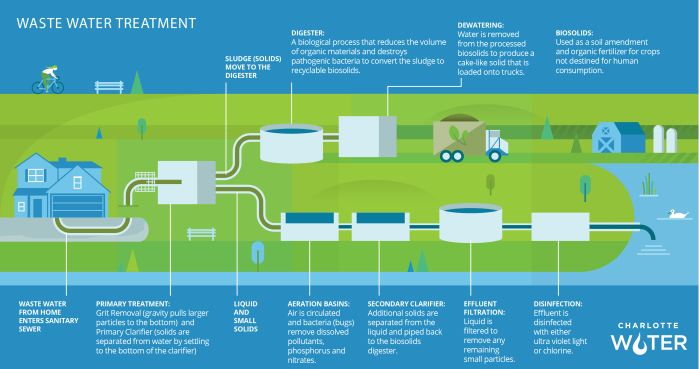
Once the wastewater leaves a business or home, it travels from your home, place of business or school through 4,200 miles of wastewater pipes to one of our treatment plants. The wastewater is separated into liquids and solids. The liquids are cleaned and put back into our creeks and streams, the solids are converted to biosolids.
The Wastewater Treatment Process
Transcript of this video appears at the bottom of this page.
Step 6: Biosolids
You may be wondering, what are biosolids?
Biosolids are nutrient-rich byproducts of wastewater treatment. They can be used on hay fields as fertilizer. Through biosolids management, solid residue from wastewater treatment is processed to reduce or eliminate pathogens and minimize odors, forming a safe, beneficial agricultural product. Biosolids are carefully monitored and must be used in accordance with regulatory requirements.
If you would like to read more about biosolids, please visit our biosolids page.
The Charlotte Water Distance Learning activities are provided in partnership with Discovery Place, Inc.
Transcript of the video: “Water Treatment Process:”
Hi, my name is Kris Del Valle. I’m a water treatment plant operator here at Lee S. Dukes Water Treatment Plant in Huntersville, North Carolina. My job is to make sure you guys have a clean source of drinking water or water you use for everyday purposes. The way we do that is by getting water from Lake Norman. It comes into our plant where we treat it with a few chemicals like chlorine and fluoride. It goes through a process with coagulation to flocculation. It will hit our sedimentation basins where it will sit and kind of let all those heavy particles fall to the ground. And from there we’ll take that water and bring it to our filters where it filters down and goes into our clear wells. And from there we send it out to you guys to use all throughout the city of Charlotte.
Transcript of the video: “Wastewater Treatment Process:”
I’m Henry Eudy at the Mallard Creek Wastewater Treatment Plant. At the wastewater treatment plant, we take in water that has been used in people’s homes and businesses in their communities. We bring in their dirty water and we treat it through a natural process that involves microorganisms, where what we call bugs eat up the pollutants in the water, and then we settle the water and filter it and disinfect it. We put it right back out into the streams and the rivers of our community where they can be enjoyed for fishing or swimming or boating. eventually will go back into the water plant and might become the drinking water that you have in your house.