Mark Bullins, Environmental Compliance Manager, shares his insights with us for Engineering Week on his work with Backflow Prevention (aka Cross-Connection Control).
I have been involved in Backflow Prevention, also known as Cross Connection Control, for over twenty years. As anyone who knows me will tell you, it is a subject I am passionate about. In my past employment, I have dealt with incidents of contamination from unprotected or illicit cross-connections and the consequences to a city’s water supply as well as the water customer. Doing my best to make sure that the drinking water Charlotte Water delivers to its customers remains pure and safe is my highest priority.
As the Environmental Compliance Manager for the Backflow Group, I oversee a team that reviews construction plans and inspects installations, making sure that water connections are properly protected with the correct backflow prevention assemblies and that they are being installed correctly for testing and maintenance. This group also creates and keeps records of these assemblies, their locations, the type, model, serial numbers, test reports, and approved testers; all the items required for compliance. They also handle questions from testers and contractors.
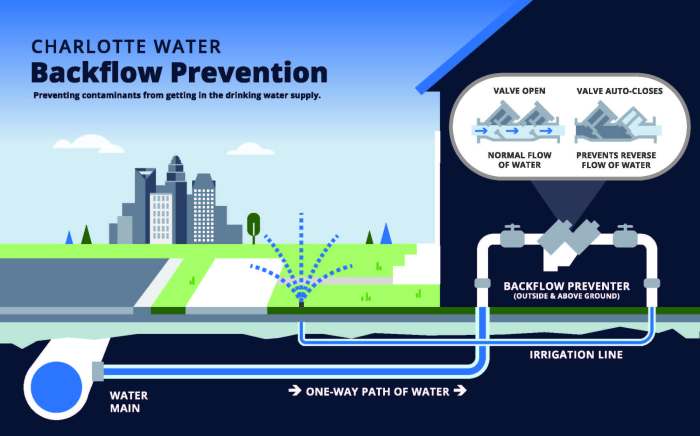
Putting it simply, once the treated water is delivered to the customer through the water meter, we do not want it to flow back into Charlotte Water’s distribution system. For example, for some water services such as a below-ground lawn irrigation system, the water can come into contact with anything found in or on the soil. This may include fertilizers, pesticides, microorganisms…etc. Fire sprinkler systems are another example; they sometimes contain water that can sit stagnant for up to a year at a time. Some fire protection systems also contain toxic chemical additives such as suppressant foam or antifreeze or have the ability for chemicals to be pumped into them. These are only a few examples of why the public water supply needs to be protected.

Another part of Charlotte Water’s Backflow Prevention program exists in the Customer Service division. This is where the water tanker and hydrant use program is located. The Customer Service group also handles calls from customers, enrolls customers in our Water Smart program, and issues letters for testing for existing customers. Backflow prevention assemblies per city ordinance must be tested annually. With their online portal, backflow testers can submit test results electronically with final acceptance by Charlotte Water.

People are often confused about what backflow prevention is, and seem to think it is about the “backwater” devices that prevent sewage from coming into a home or business. Many people do not realize that pressurized water from the distribution system can flow in a reverse direction from the water customer or how it can occur. Part of our responsibility is to educate others on the work we do.
Running a backflow prevention program is always challenging and never boring. I enjoy working at Charlotte Water and enjoy the professionalism of the people I work with.