Skip to content

A Foul Odor Outside May or May Not Be Wastewater

Have you ever ventured outside and something quite astonishing assaulted your nose?

It may be easy to pin the blame on a wastewater treatment plant that could be nearby. However, foul odors commonly emanate from a variety of sources in our community:

  • Landfills
  • Industries (i.e. paper or chemical plants)
  • Natural gas pipeline work
  • A wastewater spill
  • Wastewater plants
  • Even private plumbing

Let’s start inside the home…


Private plumbing systems are designed to prevent wastewater gases from entering residences.

All active sewer lines contain gases, and a malfunctioning plumbing system could allow gases or odors to enter the home.

Is the odor inside?

Is the odor only coming from…:

A drain that hasn’t been used recently?

We recommend for you to pour a gallon of water down the drain and see if the odor persists.

Multiple drains that are used frequently?

It may be a blockage or clog in your plumbing. Try a liquid dissolvent, please follow directions and see if this clears the clog and dissipates the odor.

A kitchen sink?

Clean the disposal (following the owner’s manual).

What you put down the drain (grease, oils, wipes) can cause odors clogging your plumbing. If the odor does not go away and is only inside your house, consider having a licensed plumber check your plumbing and vent system.
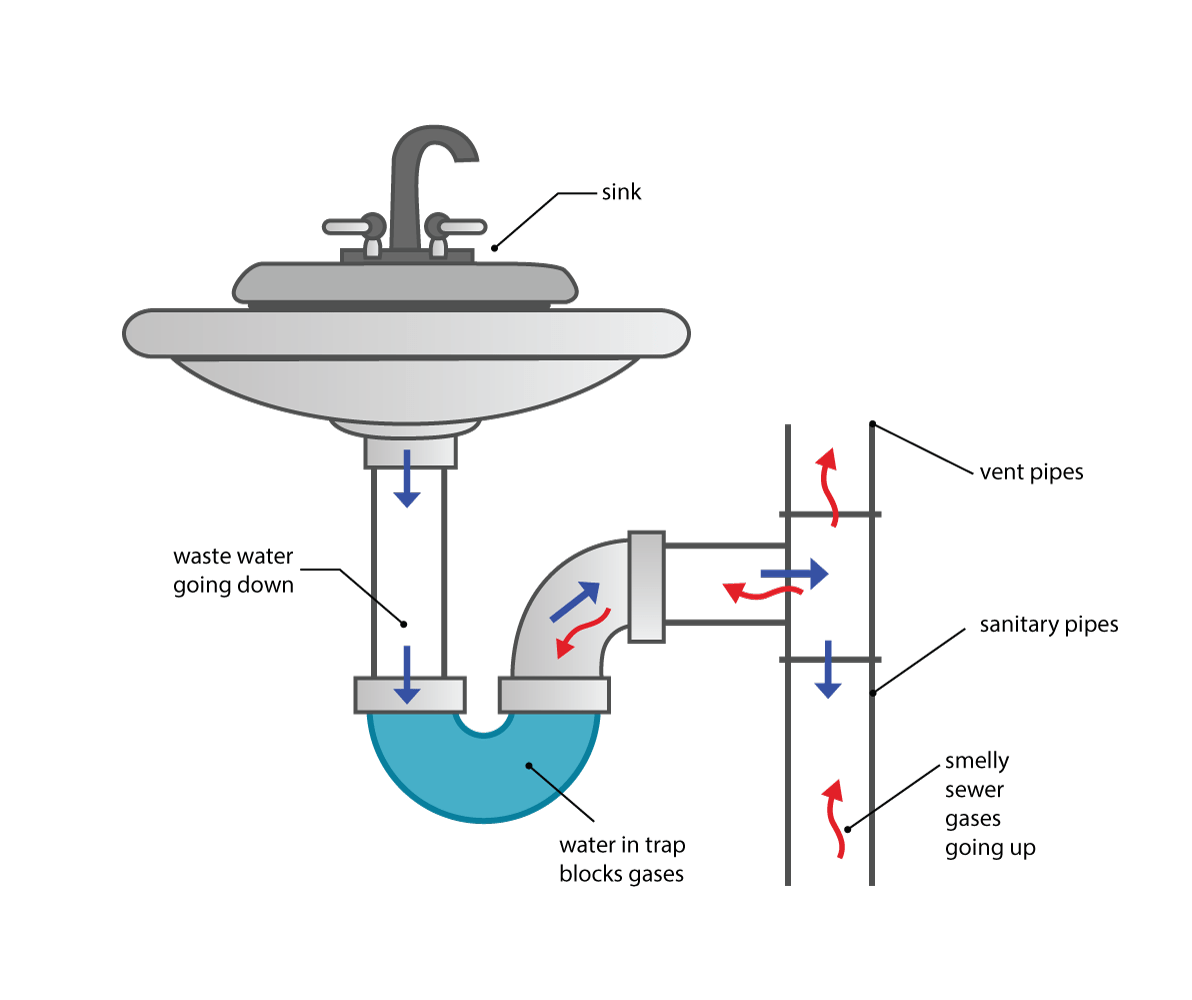
Diagram of a grey sink and faucet with white background depicts how or if a foul odor outside may be wastewater related. Drain pipes are drawn below the sink basin, use of blue downward arrows illustrates the flow of water from the sink's drain down to the rounded neck below, know as the trap. Trap is colored blue to represent water in it. The pipe then bends back upwards and then straightens out in a horizontal section before it connects to a vertical pipe. Blue arrows continue past the trap and into the vertical pipe falling downwards and heading towards the sewer. Red arrows appear pointing upwards in the vertical pipe and moving upstream against the draining water back into the horizontal pipe, getting stopped by the water in the trap. Along the route of the sink to drain to vertical pipe, indicator words appear in black font: sink, waste water going down, water in trap blocks gases, vent pipes, sanitary pipes, smelly sewer gases going up

Odor Outside Home?

Every home has a wastewater vent (on the roof) that could be the source of an odor immediately outside your home (patio, deck, etc.). The odor could be caused by a clog or blockage in your plumbing. Check with neighbors to see if they are also experiencing the odor. If it is only noticed just outside your building, contact a plumber.
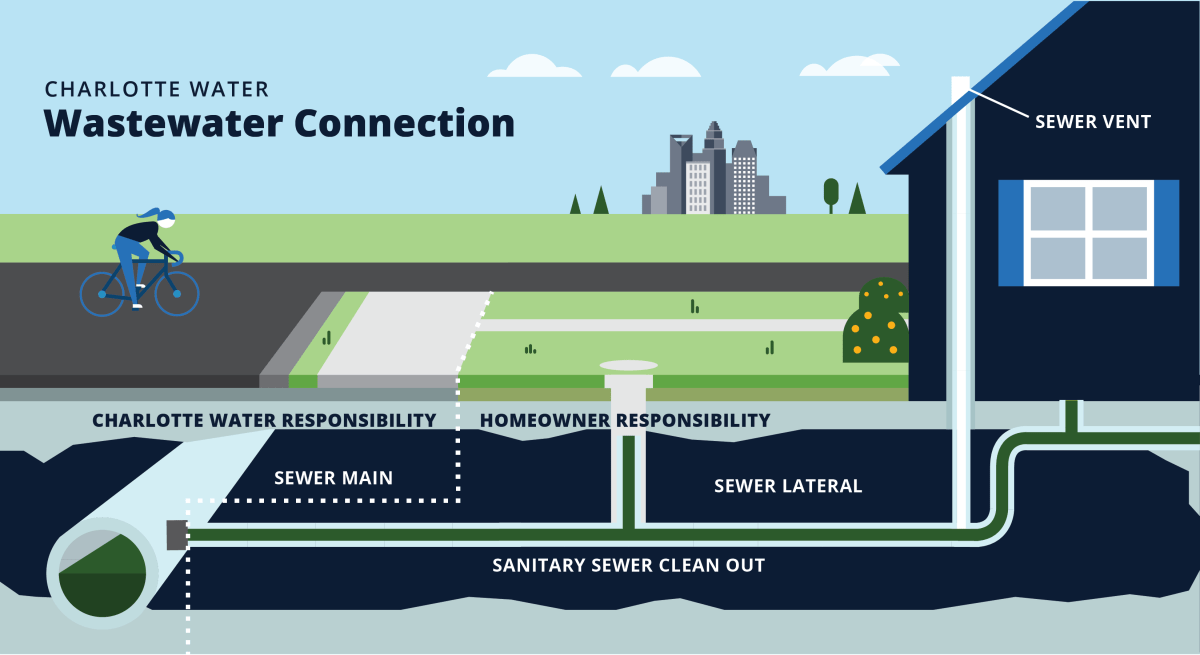
Diagram titled Charlotte Water Wastewater Connection in in black font depicts a residential street with a house on the corner, roadway is depicted with green grass on either side of a dark grey roadway and blue cyclist riding along. In the distance against a blue sky is a depiction of a city skyline. Above ground is a light grey sidewalk, green shrubs with yellow dots, and a blue one story home with blue roof and grey window. The graphic of the home depicts where sewer vent runs vertically in the house via a grey column, white font lettering Sewer Vent point to this column. Below street level, the ground area is cut away to show a side view: dirt is navy blue and network of sewer lines are dark green with light grey trim. The main is the large pipe underneath the street and is marked Sewer Main in white font; from the curb to the house is the Sewer Lateral section of pipe also marked with white font; and from a white round service port in the grass between the house and street a pipe descends vertically into the ground connecting to the Sewer Lateral, this vertical pipe is called Sanitary Sewer Clean Out and is indicated as such. Immediately below the edge of the side walk closest to the house is a dotted line indicating the area from that line to the street is Charlotte Water Responsibility in black font and to the right of that dotted line towards the house, the black font letters Homeowner Responsibility appears.

Another place to check is in your front yard. Most homes also have a white plastic lid called a cleanout, and that if not closed properly it may cause odor in the yard.

If you live on waterfront property or the road is higher than your house, you may have a low-pressure sanitary sewer system to pump your wastewater up to the gravity fed sewer system. It is possible that this system may be causing an odor in the pump basin if something is malfunctioning.
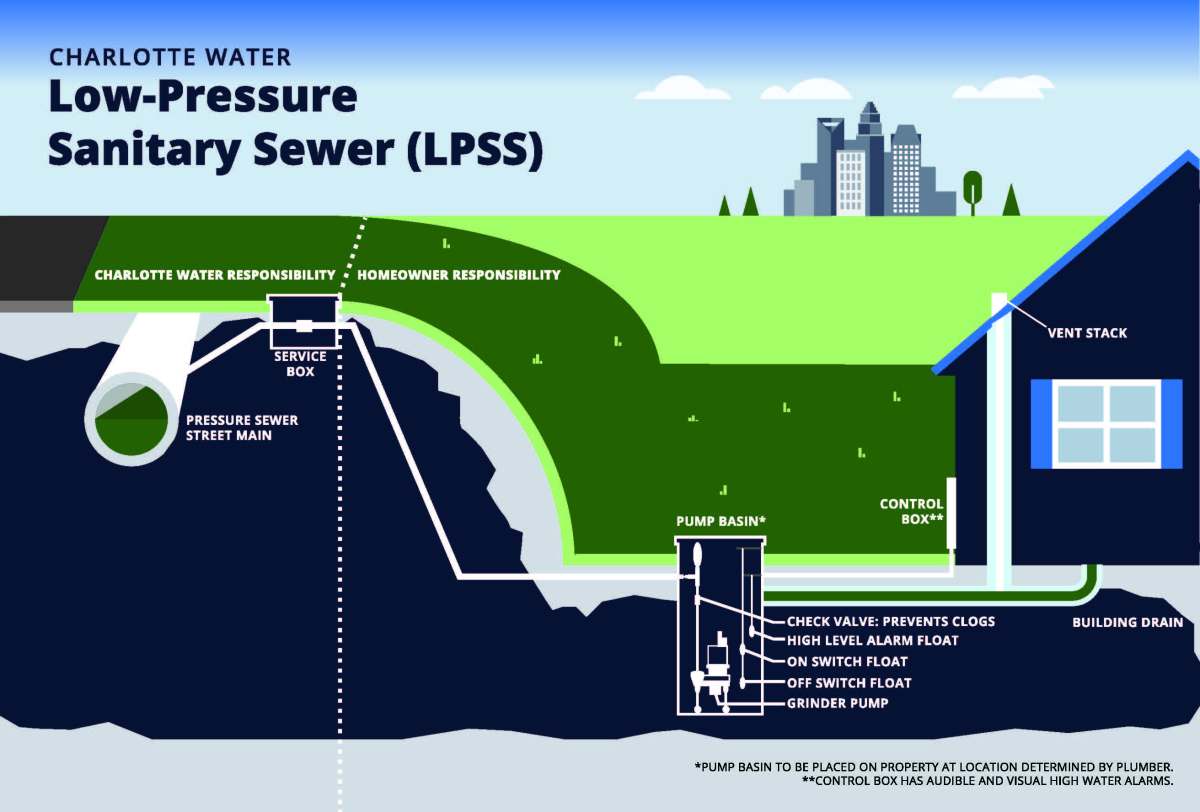
Diagram titled Charlotte Water Low-Pressure Sanitary Sewer LPSS in large navy blue font depicts the mechanized system for operating how drain water needs to be pumped from the home to the sewer line in the street when the home is situated downhill and below the sewer main. On the right side of the diagram appears a navy blue house seated on dark green area representing a downhill location. A grey column appears on the side of the house, it is indicated as a vent stack in white font caps. Note all indicators will be in white font caps on this diagram. On the front of the house is a small white rectangle indicated as a Control Box, it is connected via a white line that makes its way through the navy blue area below the house that represents soil. This line connects with a tall, rectangular space called a Pump Basin. This basin is equipped with the following items and equipment: clog preventing check-valve, high level alarm float, on switch float, off switch float, and a grinder pump. A white line indicating a pipe connects from the basin making its way uphill, terminating at street level into a square shape called a Service, Box, the pipe continues through this box and then under the street and into a very large grey pipe indicated as the Pressure Sewer Street Main. Back at the house, there is a green pipe that runs from underneath the house, also connecting to the Service Basin, it is indicated as the Building Drain. Over by where the home's land levels out at street level is a dotted line that runs from the horizon of the diagram across the green field, and straight to the bottom of the diagram through the blue soil. To the right of this dotted line and also to the right of the Service Box, are the words Homeowner Responsibility. To the left of the dotted line including the Service Box the words Charlotte Water Responsibility appear. At the very bottom right of the diagram in a pale blue field appear 2 footnote. The first is relative to the Pump Basin, Pump Basin to be placed on property at location determined by plumber. The second footnote is relative to the Control Box, Control Box has audible and visual high water alarms.

What Can Cause A Wastewater Type Odor?

Sewage odor may be a sign of a nearby wastewater overflow that needs immediate attention.

​If you see or suspect a wastewater overflow or spill, call 311 or 704-336-7600 – 24 hours a day, seven days a week. If calling after hours, please say or select ‘wastewater emergency’ to speak to our dispatchers.

If you live beside a wastewater treatment plant, there may be some occasions when a smell is noticeable outside the property. Wastewater odor can be noticeable during warm temperatures, buildup of debris in pipes, or low flow during some nights and weekends.

CLTWater Takes Odor Seriously

For decades, wastewater treatment plants that were once neighbors to farms and forests are now neighbors to residential neighborhoods and businesses. In fact, there’s a wastewater treatment plant in the Little Sugar Creek / South Park area! As people moved closer to our plants, CLTWater invested millions on odor reduction. We aren’t baking bread, but we try hard to make the treatment of our community’s wastewater less noticeable.

Air scrubbers, carbon filters, bio-filters, help CLTWater reduce odors that can occur during the wastewater treatment process. We are committed to safely treating wastewater and reducing odors. We appreciate your input to help us identify potential odors.

How Do I Report an Odor or Sewer Spill?

If you see or suspect a wastewater overflow, call 311 – 24 hours a day, seven days a week (say or select wastewater emergency).

  • Try to locate the source.
  • If it is coming from a manhole or a creek, call 311 or 704-336-7600 and provide the closest address.
  • A repair crew will respond quickly, investigate the cause and repair any publicly owned pipes, if needed.

Links

Discover more from Charlotte Water Blog

Subscribe now to keep reading and get access to the full archive.

Continue reading

document.addEventListener('DOMContentLoaded', function () { const observer = new MutationObserver(() => { document.querySelectorAll('.jetpack-instant-search__search-result-expanded__image').forEach(img => { if (!img.hasAttribute('alt')) { img.setAttribute('alt', ''); } }); }); observer.observe(document.body, { childList: true, subtree: true }); });