Skip to content

Why Does Wastewater Cost More On My Water Bill?

Treating wastewater is complex, using sophisticated biological systems, multiple filters, and modern disinfection methods.

So why does your sewer part of the monthly bill cost more than water usage?

The Short Answer:

It is easier and cheaper to treat lake water to make it drinkable than to treat the community’s wastewater (industrial, commercial, and residential) and make it clean enough to reintroduce into a creek or river.

Water leaving the plant must be free of harmful pollutants to protect fish, turtles, birds, and other creatures that depend on the creek.

Below is a step-by-step guide for turning lake water into potable or drinking water.
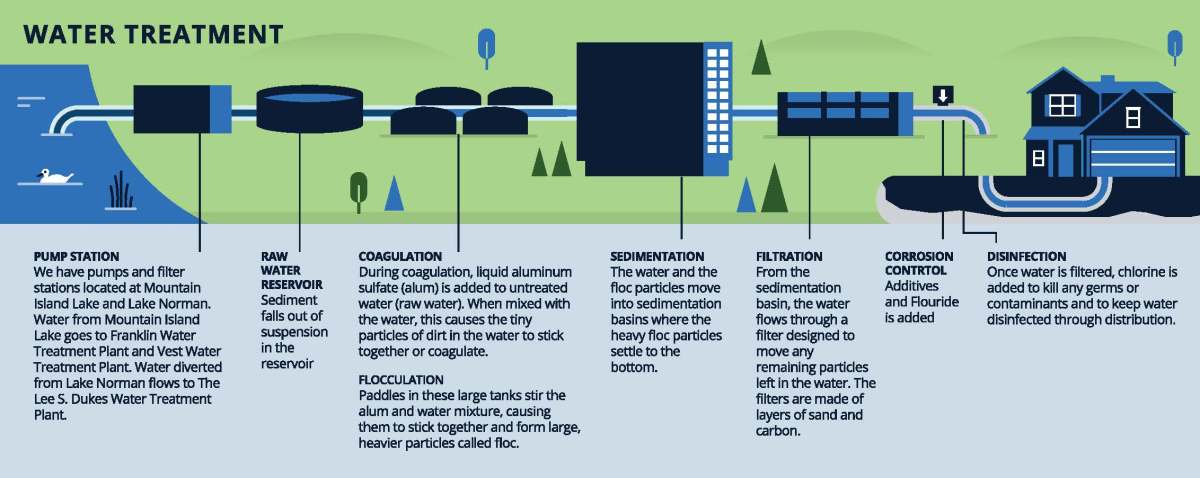
Diagram titled with black caps font top left, Water Treatment, depicts how water from nature is treated an moved via a 7 step journey for drinking in the home. On this diagram all water pipes are blue, bodies of water are light blue, all buildings and structures are navy blue and everything in between is light grassy green. All other descriptive fonts are navy blue. From the left is a blue area representing a lake with a pipeline connecting the natural body of water to stop 1 - Pump Station, We have pumps and filter stations located at Mountain Island Lake and Lake Norman. Water from Mountain Island goes to Franklin Water Treatment Plant and Vest Water Treatment Plant. Water diverted from Lake Norman flows to The Lee S. Duke Water Treatment Plant. From there the water moves to stop 2 - Raw Water Reservoir, Sediment falls out of suspension in the reservoir; a group of large covered round tanks is stop 3 - Coagulation, During coagulation, liquid aluminum sulfite or alum is added to untreated raw water. When mixed with the water this causes the tiny particles of dirt in the water to stick together or coagulate. At this same location, the water has an additional stop, stop 3a - Flocculation, Paddles in large tanks stir the alum and water mixture, causing them to stick together and form large, heavier particles called floc. Next is stop 4 - Sedimentation, the water and the floc particles move into sedimentation basins where the heavy floc particles settle to the bottom. The water then moves through pipes to a series of filtration tanks during Stop 5, Filtration - from the sedimentation basin, the water flows through a filter designed to move any remaining particles left in the water. The filters are made of layers of sand and carbon. From there the water moves on to the last leg of it journey before it reaches the home: Stops 6 and 7: Corrosion Control, additives and Fluoride are added and Disinfection - Once water is filtered chlorine is added to kill any germs or contaminants and to keep water disinfected through distribution. The water is now ready to enter the home for drinking and other usage.

And here are the steps to turn your wastewater into creek-able water.
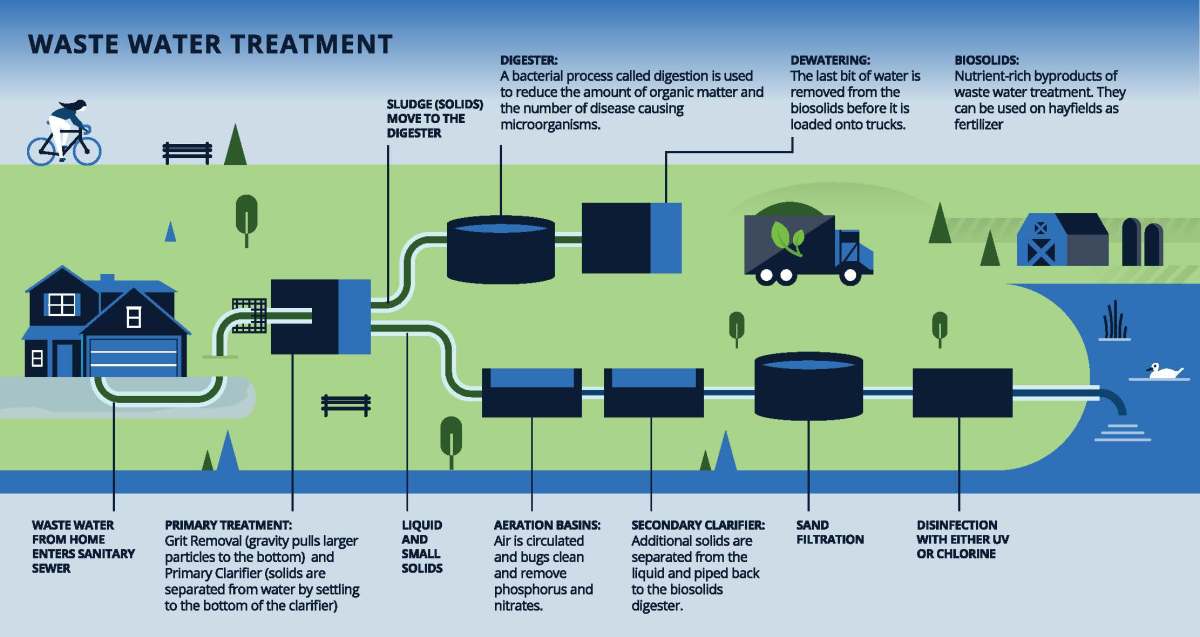
Diagram titled in blue caps font Waste Water Treatment at top left describes the workflow of waste water treatment from residential home on its 10 step journey to the waterways. Landscape of the diagram is blue sky at the top, green space representing grass in the middle and the bottom depicts a water way connecting to a lake. All the structures described are using a graphic design of navy blue and light blue tones representing any body of water aspect, all pipes connecting everything are olive green. 1- residential home with navy blue caps font next to it, Waste Water From Home Enters Sanitary Sewer; 2 - large gravity filter structure with tank is identified with blue caps font as Primary Treatment: Grit Removal gravity pulls larger particles to the bottom and Primary Clarifier solids are separated from water by settling to the bottom of the clarifier; two green pipes leave that structure, one is item 3 - blue caps font Sludge Solids move to the digester as identified by line pointing to green pipeline and the other is item 4 - blue caps font Liquid and Small Solids point to another section of green pipe; from there material move through to two basins 5 - Aeration Basins: Air is circulated and bugs clean and move phosphorus and nitrates, the moving into item 6, Secondary Clarifier-Additional solids are separated from the liquid and piped back to the biosolids digester; from there the material follows the pipeline to item 7: Sand Filtration in a round tank followed by a trip to item 8: a tank for Disinfection with either UV or Chlorine and from there the pure water goes out to natural water source such as a lake. Now moving back to that second pipe routing to item 3; that material moves to item 9, a large round tank identified as a Digester- a bacterial process called digestion is used to reduce the amount of organic matter and the number of disease causing microorganisms; from that tank the material travels to a pipe to item 10, a building with a tank identified for Dewatering, the last bit of water is removed from the biosolids before it is loaded onto trucks where it will seek its final stop as Biosolids: Nutrient-rich byproducts of waste water treatment, they can be used on hayfields as fertilizer

There are more steps to the wastewater treatment process than water treatment process.

Charlotte Water (CLTWater) only uses water meters to measure usage, so wastewater usage is calculated based on that water usage up to a limit or cap.

Energy and chemical costs are higher for wastewater treatment processes, hence the higher cost for wastewater treatment vs. water treatment on a water bill.

The cost to treat wastewater and meet federal regulations continues to increase. Our goal is to always meet and exceed regulations to ensure cleaner water goes into our creeks.

Stop right here if you’re satisfied! The Longer Answer gets a bit technical about how your billing works.

The Longer Answer:

CLTWater pays for water and wastewater services via usage and billing fees, not taxes (contrary to popular belief). CLTWater posted the official Revenue Manual that details all fees.

How can I help reduce my water / sewer bill and rate increases?
Toss all trash in the trashcan, not down a drain. Did you know that ‘flushable’ wipes clog pipes and require manually pulling them out of pumps? Wipes can cause expensive repairs and maintenance.

Additional resources:

Discover more from Charlotte Water Blog

Subscribe now to keep reading and get access to the full archive.

Continue reading

document.addEventListener('DOMContentLoaded', function () { const observer = new MutationObserver(() => { document.querySelectorAll('.jetpack-instant-search__search-result-expanded__image').forEach(img => { if (!img.hasAttribute('alt')) { img.setAttribute('alt', ''); } }); }); observer.observe(document.body, { childList: true, subtree: true }); });