All posts by Bella Nani

Meet the 2026 Utility Tech I Apprentices: Growth, Goals, and What’s Next

Every career begins with a first step, but what comes next is just as important.

Charlotte Water’s Utility Tech I Apprenticeship is designed not only to train employees for today’s work, but to help them build long-term careers. Through hands-on experience, mentorship, and professional development, apprentices gain the skills and confidence needed to grow within the organization.

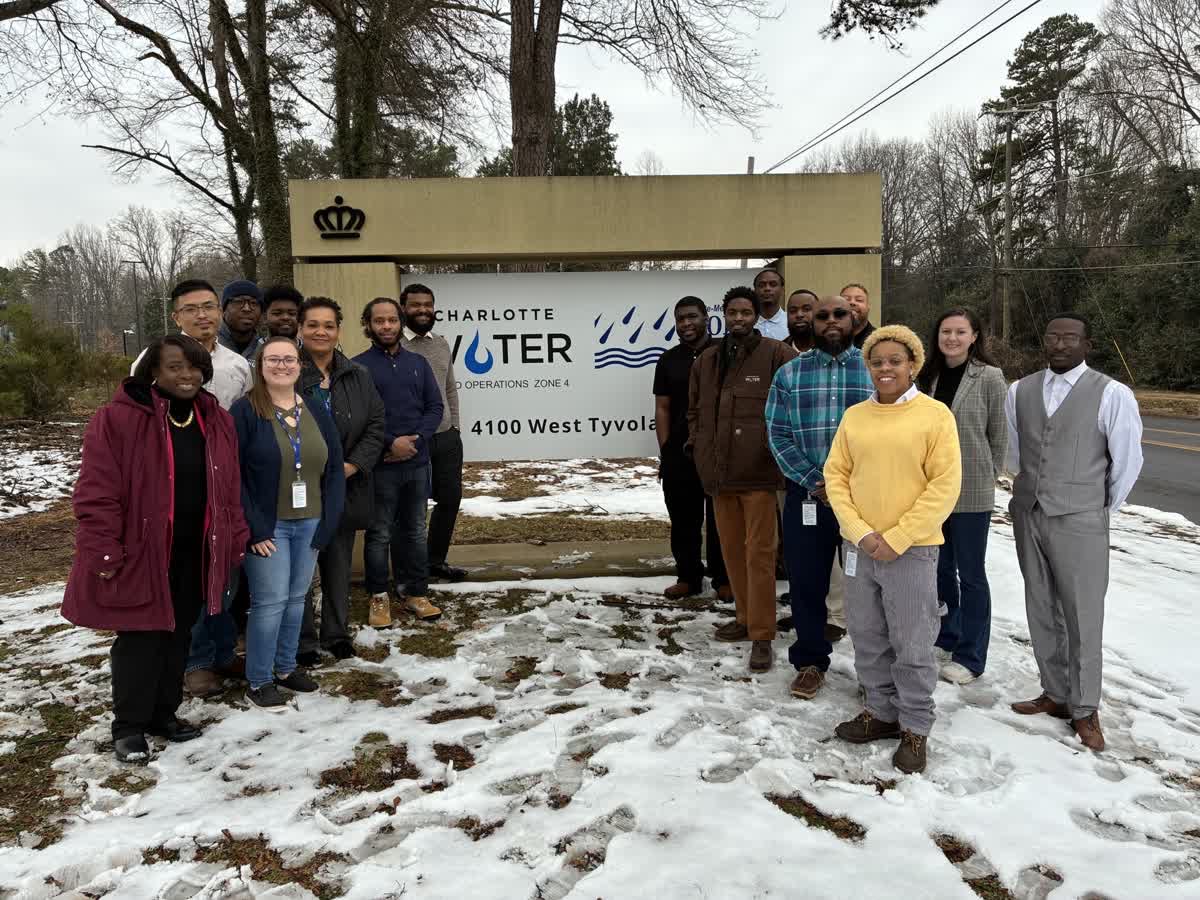
In the final installment of our three-part series, we hear from several apprentices about their future goals and what they hope to achieve through the program.

Portrait of Tyis Cunningham wearing a green button-down shirt and smiling against a blue background.

Tyis Cunningham

Before becoming an apprentice, Tyis built a career in construction and heavy equipment operation, working on projects ranging from commercial development to infrastructure work.

His experience operating machinery and working in the field provided him with a strong foundation for the hands-on work in water utilities. Tyis said the apprenticeship offers an exciting opportunity to expand his skills in a new industry.

“I’m excited to learn something different and earn new certifications,” he said.

He is particularly interested in continuing his education while building his career. In addition to pursuing industry certifications, he hopes to take business and accounting classes to help him grow professionally and personally.

“I want to leave a legacy,” he said. “I want to make sure I’m building something that lasts.”

Outside of work, Tyis enjoys spending time outdoors hunting, fishing, and riding ATVs.

Portrait of Keijuan Green wearing a light gray polo shirt against a blue background.

Keijuan “KayJay” Green

Before joining Charlotte Water, Keijuan Green, who goes by KayJay, gained experience across a wide range of industries, including construction, landscaping, railroad operations, and restaurant management. Throughout those roles, he developed strong leadership and communication skills that continue to shape his approach to his work today.

“I’ve always been someone who can work with anybody,” he said. “No matter someone’s background, I can find a way to connect and work together.”

KayJay had also pursued coursework in construction and plumbing at Central Piedmont Community College, making the apprenticeship a natural next step toward the hands-on trade career he had been pursuing. He hopes to continue developing his leadership abilities and eventually move into an operator role.

“I finally feel like I’ve found a career,” he said. “I want to grow here and build something long-term.”

Outside of work, KayJay is a former two-time state champion wrestler who spent much of his youth competing in athletics.

Portrait of Allen Blackmann wearing a patterned black-and-cream collared shirt and smiling against a blue background.

Allen Blackmann

Allen entered the apprenticeship with a background in aviation work at the airport and technical training through Goodwill’s training program. While the water and wastewater field was new to him, the opportunity to build a long-term career quickly stood out.

“Charlotte Water has a lot to offer,” he said. “It’s not just short-term. If you put in the time and learn, it benefits you in the future.”

As an apprentice, Allen focuses on learning from experienced crew members and building the skills needed to succeed in the field. Much of the training so far has emphasized communication, teamwork, and professionalism.

“It’s not just about the labor,” he explained. “They’re really building your character and teaching you how to communicate and work with people.”

Looking ahead, Allen hopes to grow within the organization and eventually step into leadership opportunities once he gains more experience in the field.

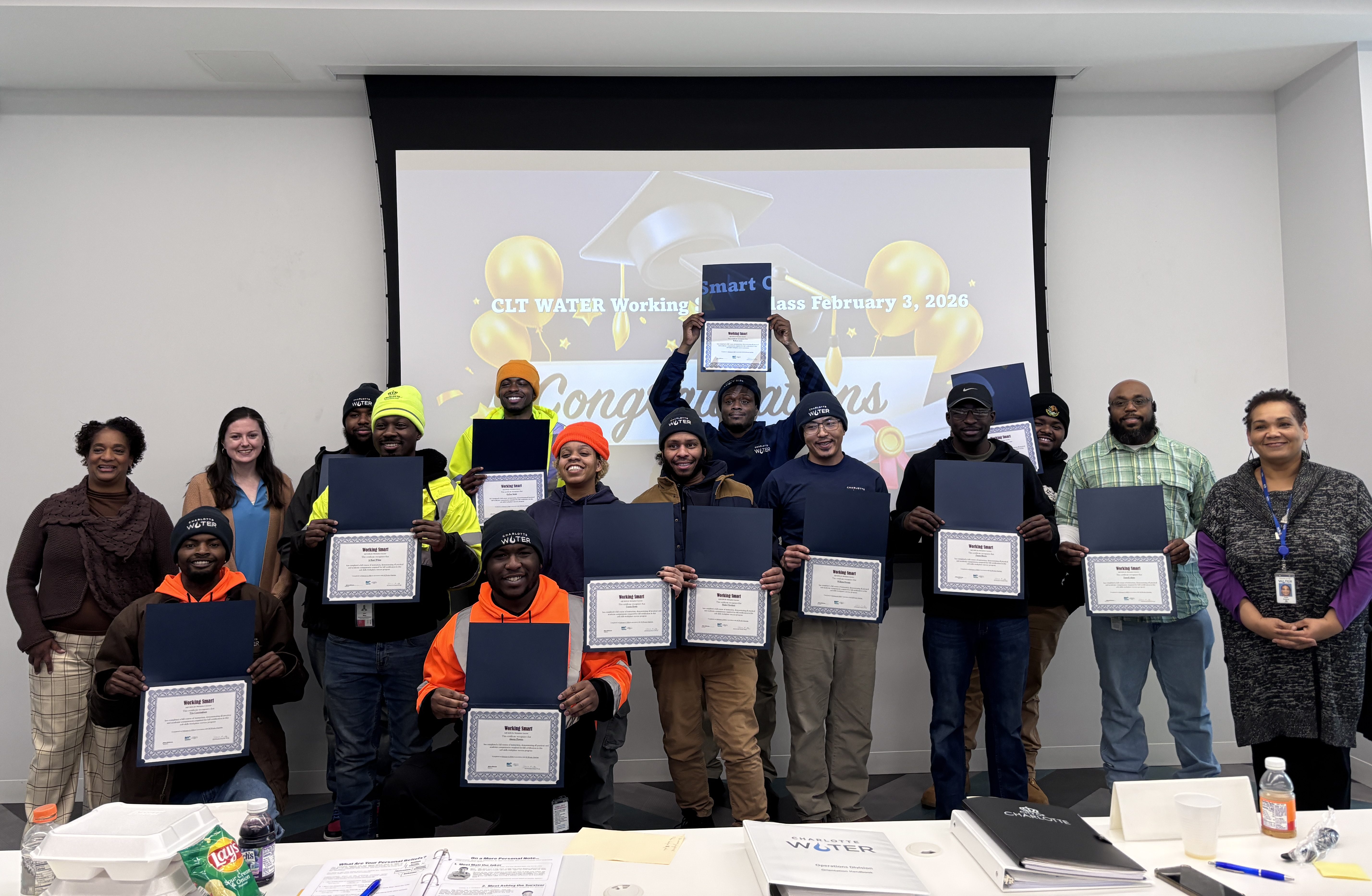
Apprentices lined up for a group picture, an apprentice named Ten sits at a table in the front with two instructors, signing a paper for completing training.
A group photo taken at the apprenticeship signing

Building the Future of Charlotte Water

The Utility Tech I Apprenticeship program reflects Charlotte Water’s investment in developing skilled employees and creating long-term career pathways. Each apprentice brings unique experiences, goals, and perspectives, but they share a common commitment to learning, teamwork, and serving the community.

As this year’s cohort continues their training, they are not only developing technical skills but also laying the foundation for the next generation of water utility professionals.

Getting to learn about each apprentice’s story has been a privilege, and their passion and commitment make it clear that the future of our community is in good hands!

Meet the 2026 Utility Tech I Apprentices: Inside the Apprenticeship

What happens after you’re accepted into the program?

While each apprentice arrived at Charlotte Water from a different path, they now share a common experience: structured training, hands-on preparation, and a culture built on accountability and teamwork. The Utility Tech I Apprenticeship blends technical instruction with personal development, ensuring participants are prepared not only for the work itself but also for long-term growth within the organization.

In this second installment of our three-part series, we take a closer look at what the apprenticeship experience feels like from the inside.

Headshot of DJ who has short curly dark hair and a full beard, smiling at the camera, wearing a tan sweater over a white collared shirt, against a blue blurred background.

DJ Hobbs

For DJ, the apprenticeship represents more than a career transition. Coming from a background in armed security and customer service, he was ready to move from contract work into something more stable and long-term. While new to water and wastewater, he quickly found that the program offered something he had not experienced before.

Each day begins at 7:30 a.m., often with a team-building activity that helps the group connect before diving into lessons. From emotional awareness and conflict resolution to preparing for life as a full-time employee, the training focuses on more than technical skills.

“They really care about your mental well-being,” DJ said. “They’re preparing you for real life.”

What surprised him most was the culture. After his son’s birth, his cohort signed a card and celebrated with him. “It feels like I have another family,” he shared.

Headshot of J'Mani who has short black hair and glasses, wearing a white dress shirt and light gray vest, looking at the camera with a neutral expression, against a blue blurred background.

J’Mani Moore

J’Mani entered the apprenticeship with prior experience in water and wastewater operations, having worked in facility maintenance for lift stations and treatment plants in Gaston County. For him, joining Charlotte Water was a step deeper into a field he already enjoyed.

While the technical training is valuable, J’Mani said the emphasis on interpersonal skills and emotional intelligence has stood out the most.

“I’m kind of in a rebranding phase of my life,” he shared. “Refining my attitude and emotional intelligence is something I can use every day.”

Even with a 50-minute commute and balancing family responsibilities, he views the structured training as an investment in both his career and personal growth.

Headshot of Akeem who has short dark hair and trimmed facial hair, wearing a black polo shirt, looking at the camera with a slight smile, against a blue blurred background.

Akeem Flowers

Akeem joined the program with experience in warehouse management, carpentry, and appliance installation. While new to water and wastewater, he quickly recognized that the apprenticeship offers more than technical instruction.

For Akeem, learning professionalism and workplace communication has been especially impactful. “Now coming in here and learning how I should be able to talk to coworkers, bosses, managers… it makes me feel more prepared,” he said.

He was also surprised by the level of organizational support. From great benefits to leadership that encourages internal mobility and career pathways, Akeem said the program feels like an opportunity to grow within a company that invests in its people.

Headshot of Darrell who has glasses and a full beard wearing a green and blue plaid button-down shirt, standing in front of a textured blue background with soft white accents.

Darrell Akrie

Darrell entered the apprenticeship with prior experience in sewer and water operations, having worked in both York County and with Charlotte Water. For him, the program represents continued growth within a field he already knows well.

He describes each day as an opportunity to remain open-minded and learn new systems as operations evolve. Operator training has been especially meaningful, including hands-on exposure to equipment such as front loaders and excavators.

Darrell has been impressed by the consistency of communication and teamwork throughout the program. Even as they adapt to new digital tools and technologies, he and his cohort rely on one another through collaboration and shared support.

For Darrell, completing the apprenticeship means unlocking new possibilities and continuing to build a career rooted in service and growth.

Group of apprentices wearing bright orange safety jackets and hard hats posing together inside a water treatment plant, standing in front of large blue machinery and yellow metal stairs.
Apprentices inside a Water Treatment Plant

While each apprentice’s experience is unique, a common theme continues to emerge: the Utility Tech I Apprenticeship is not simply job training. It is preparation for a sustainable career, built on technical skills, personal development, and a strong team foundation.

In our final installment, we will explore what comes next for these apprentices. From long-term goals to the future, they hope to build within Charlotte Water.

Meet the 2026 Utility Tech I Apprentices: How They Got Here

Behind every apprenticeship is a story.

Charlotte Water’s Utility Tech I Apprenticeship brings together individuals from different industries, experiences, and stages of life, all united by a shared goal: building a meaningful, long-term career in public service. This year’s cohort did not follow one single path to get here. Some pivoted from different industries. Some applied more than once. Others are continuing family legacies or stepping into a completely new trade.

In this first installment of our three-part series, we are highlighting how four apprentices found their way to Charlotte Water and what motivated them to take that next step.

A headshot picture of Ten, an apprentice, smiling. She has curly blonde hair and wears clear framed glasses. She's wearing a yellow sweater with a white collar.

Teneia “Ten” Howie

Teneia, who goes by Ten, grew up in Monroe, North Carolina, and spent the past three years working part-time at American Airlines, while searching for a long-term career path. Even though she absolutely loved her position at American Airlines, she felt ready for something different. This led to her enrollment at Goodwill’s trade school program, where she earned certifications and received career placement support.

With support from her trade school, Ten refined her resume and successfully secured a spot in the apprenticeship on her second application.

“It’s been a process,” she shared, reflecting on her journey. But a process well worth the hard work and effort she’s put in.

Although new to the water and wastewater field, Ten embraced the apprenticeship as a fresh start and an opportunity to grow in a stable, hands-on career.

A headshot picture of Shakir, smiling and wearing a blue polo shirt.

Shakir Cleveland

Shakir Cleveland brings decades of hands-on experience to the program. He began working hands on jobs at 17, spending years in construction and outdoor labor roles. Through his family’s plumbing business, he also gained early exposure to working with tools and trade work.

While he excelled in office-based customer service and mortgage roles, even earning high-performance recognition, he realized something important about himself: he did not thrive behind a desk.

“I just did not like being stuck in an office setting,” he said.

After exploring different paths, Shakir found that working outdoors felt like where he belonged. The Utility Tech I Apprenticeship offered the structure, teamwork, and long-term career opportunity he had been searching for.

A headshot picture of William, he has thin framed glasses and a tan button up shirt.

William Devizia

William Devizia was born in Korea and raised in Charlotte, bringing extensive utilities experience to the apprenticeship. Before joining Charlotte Water, he worked with Honeywell and later contracted with Piedmont Natural Gas and Duke Energy. In those roles, he helped transition traditional AMR meters to AMI “smart” meters, enabling remote readings and increased efficiency.

After consistently performing well in his previous roles, William was hired full-time and continued building his technical expertise. Although new specifically to water and wastewater operations, he saw the Utility Tech I Apprenticeship as a natural next step in his utilities career.

For William, the program represents continued growth and long-term opportunity within the industry.

A headshot picture of Emiliano, he's smiling and wearing a grey shirt.

Emiliano Guatemala

At just 20 years old, Emiliano is already focused on building stability for his family. A father of two, he previously worked in HVAC installation, gaining hands-on experience in physically demanding environments.

Emiliano was drawn to the apprenticeship for its long-term benefits and advancement opportunities. He also follows in his father’s footsteps, who has worked at Charlotte Water for several years.

“I love it,” he said, describing the program so far. “And now I know my kids are going to be set.”

For Emiliano, an apprenticeship is more than a job. It is a foundation for growth, both professionally and personally.

A picture from behind of a couple of the apprentices on a work site, wearing their PPE. The sun is shining on a clear day.
Apprentices touring a Water Plant

These four apprentices represent just a portion of this year’s Utility Tech I cohort, but their journeys highlight the diverse paths that lead to public service careers at Charlotte Water.

In Part Two of this series, we will take a closer look at what it is really like to be a Utility Tech I apprentice, from day-to-day training to the skills they are developing along the way.

Making the Most of Biosolids: Affordable Moves Toward Sustainable Biosolids Use

Based on an interview with Giovanna Forti Portiolli, Charlotte Water’s Resource Recovery Manager

Charlotte Water manages the largest public water and wastewater utility system in the Carolinas, serving more than one million people across Mecklenburg County. With five water resource recovery facilities (WRRFs) treating a combined average of 86 million gallons per day, the system also produces a significant amount of biosolids, about 120,000 wet tons per year. Traditionally, most of this material has been sent for beneficial reuse through land application, but rapid regional growth, tight storage capacity, and operational challenges have made that increasingly difficult.

I sat down with Giovanna Forti Portiolli, Charlotte Water’s Resource Recovery Manager, to discuss how Charlotte Water has navigated these hurdles without relying on significant immediate capital investments. Instead of waiting years for large-scale upgrades, her team found creative, collaborative, and cost-effective solutions that keep biosolids moving toward beneficial reuse rather than landfills.

Below are the key strategies and outcomes her team has piloted across our facilities.

Tackling Foreign Debris with a Sludge Screen Pilot at Irwin Creek WRRF

For almost two years, all of Irwin Creek’s biosolids were being landfilled out of precaution when the team started observing foreign debris finding its way to the final biosolids product. Landfilling biosolids is expensive, not sustainable, and wasteful of important nutrients and organic matter.

The operations team piloted a rental sludge screen to fine screen foreign debris out before dewatering the sludge. The impact was immediate. The utility was able to go back to beneficially reusing and recycling nutrients and organic matter from the biosolids, while also saving on landfill tipping fees. Renting the equipment also gave Charlotte Water time to test, refine, and validate the technology before purchasing and installing a permanent unit. This is a key example of how improperly disposing trash at home can have a direct negative impact in the community (e.g., higher costs and wasting important resources).

The image shows three columns of debris found in Biosolids. The columns are Nurdles/Pellets, Labels/Stickers, and Hair, from left to right.
Examples of debris causing this specific issue
Finding Storage Space

Biosolids storage is a valuable and often expensive resource to expand. Instead of launching a multimillion-dollar capital project, Charlotte Water took a more resourceful approach by looking inward at what already existed.

At Charlotte Water’s largest wastewater facility, McAlpine Creek Water Resource Recovery Facility, staff identified old, unused, or obsolete equipment inside the Residuals Management Facility that could be safely demolished to free up staging areas for future use. This newly reclaimed space eased bottlenecks and reduced the strain on limited storage. The effort generated savings of at least $135,000 every year.

A cleared-out space in the Biosolids storage. A large concrete space with barriers on the sides give potential room for biosolids. A truck has its lights on in the distant background of the facility.
Cleared out room for Biosolids storage
Strengthening Contractor Partnerships and Diversifying Outputs

Biosolids management is a shared effort. Charlotte Water works closely with its biosolids contractor to haul and land apply material, and Giovanna emphasized how important that relationship became during this transition.

Together, the team is exploring new outlets for beneficial reuse, including adding the ability to send a portion of biosolids to a composting facility. Furthermore, team is currently studying additional beneficial use outlet alternatives (e.g., alternative landfill daily cover, stormwater research). Additional reuse pathways reduce dependency on a single outlet when weather or operational conditions limits traditional land application. This adds more flexibility during challenging periods

To the right in the image a machine used to apply Biosolids onto land is spraying and distributing biosolids throughout a field. The sky is blue and there is a line of trees in the background.
Land application of Biosolids
Shifting to Seven-Day Dewatering at McAlpine Creek

For years, McAlpine operated on a five-day, twenty-four-hour dewatering schedule. This schedule created added operational pressure and challenges. The operations team transitioned to continuous seven-day operations, which streamlined biosolids flow and optimized every part of the process.

The change improved equipment efficiency, translated into a slight increase in cake solids, which help utilize storage more effectively. Even a small improvement in cake solids can reduce haul volumes and strengthen land application operations.

A Bigger Picture: Innovation Without a Giant Price Tag

All of these efforts share a commonality. Instead of waiting for long-term capital funding, staff, contractors, and consultants collaborated to identify practical, low-cost improvements that delivered benefits immediately.

Each strategy followed the same pattern:

• Start small

• Pilot first

• Measure everything

• Scale what works

And above all, stay open to ideas that come from every level of the organization.

These low-cost wins demonstrate how Charlotte Water is continuing to guide biosolids management toward higher efficiency, sustainable environmental outcomes, and reduced landfill dependency, while serving one of the country’s fastest-growing regions.

For questions, you can email Giovanna.FortiPortiolli@CharlotteNC.gov