Tag Archives: biosolids

Making the Most of Biosolids: Affordable Moves Toward Sustainable Biosolids Use

Based on an interview with Giovanna Forti Portiolli, Charlotte Water’s Resource Recovery Manager

Charlotte Water manages the largest public water and wastewater utility system in the Carolinas, serving more than one million people across Mecklenburg County. With five water resource recovery facilities (WRRFs) treating a combined average of 86 million gallons per day, the system also produces a significant amount of biosolids, about 120,000 wet tons per year. Traditionally, most of this material has been sent for beneficial reuse through land application, but rapid regional growth, tight storage capacity, and operational challenges have made that increasingly difficult.

I sat down with Giovanna Forti Portiolli, Charlotte Water’s Resource Recovery Manager, to discuss how Charlotte Water has navigated these hurdles without relying on significant immediate capital investments. Instead of waiting years for large-scale upgrades, her team found creative, collaborative, and cost-effective solutions that keep biosolids moving toward beneficial reuse rather than landfills.

Below are the key strategies and outcomes her team has piloted across our facilities.

Tackling Foreign Debris with a Sludge Screen Pilot at Irwin Creek WRRF

For almost two years, all of Irwin Creek’s biosolids were being landfilled out of precaution when the team started observing foreign debris finding its way to the final biosolids product. Landfilling biosolids is expensive, not sustainable, and wasteful of important nutrients and organic matter.

The operations team piloted a rental sludge screen to fine screen foreign debris out before dewatering the sludge. The impact was immediate. The utility was able to go back to beneficially reusing and recycling nutrients and organic matter from the biosolids, while also saving on landfill tipping fees. Renting the equipment also gave Charlotte Water time to test, refine, and validate the technology before purchasing and installing a permanent unit. This is a key example of how improperly disposing trash at home can have a direct negative impact in the community (e.g., higher costs and wasting important resources).

The image shows three columns of debris found in Biosolids. The columns are Nurdles/Pellets, Labels/Stickers, and Hair, from left to right.
Examples of debris causing this specific issue
Finding Storage Space

Biosolids storage is a valuable and often expensive resource to expand. Instead of launching a multimillion-dollar capital project, Charlotte Water took a more resourceful approach by looking inward at what already existed.

At Charlotte Water’s largest wastewater facility, McAlpine Creek Water Resource Recovery Facility, staff identified old, unused, or obsolete equipment inside the Residuals Management Facility that could be safely demolished to free up staging areas for future use. This newly reclaimed space eased bottlenecks and reduced the strain on limited storage. The effort generated savings of at least $135,000 every year.

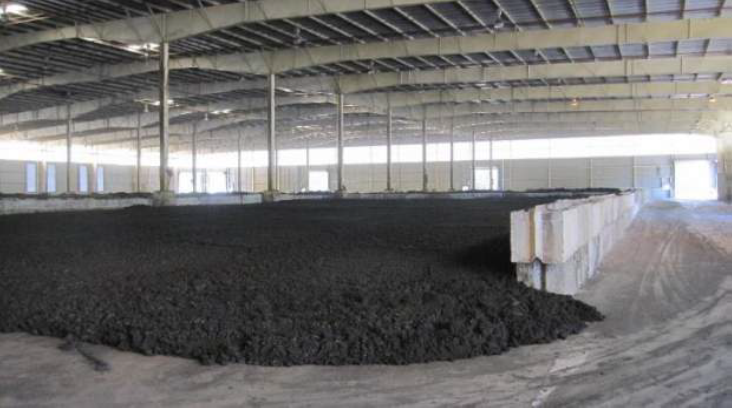
A cleared-out space in the Biosolids storage. A large concrete space with barriers on the sides give potential room for biosolids. A truck has its lights on in the distant background of the facility.
Cleared out room for Biosolids storage
Strengthening Contractor Partnerships and Diversifying Outputs

Biosolids management is a shared effort. Charlotte Water works closely with its biosolids contractor to haul and land apply material, and Giovanna emphasized how important that relationship became during this transition.

Together, the team is exploring new outlets for beneficial reuse, including adding the ability to send a portion of biosolids to a composting facility. Furthermore, team is currently studying additional beneficial use outlet alternatives (e.g., alternative landfill daily cover, stormwater research). Additional reuse pathways reduce dependency on a single outlet when weather or operational conditions limits traditional land application. This adds more flexibility during challenging periods

To the right in the image a machine used to apply Biosolids onto land is spraying and distributing biosolids throughout a field. The sky is blue and there is a line of trees in the background.
Land application of Biosolids
Shifting to Seven-Day Dewatering at McAlpine Creek

For years, McAlpine operated on a five-day, twenty-four-hour dewatering schedule. This schedule created added operational pressure and challenges. The operations team transitioned to continuous seven-day operations, which streamlined biosolids flow and optimized every part of the process.

The change improved equipment efficiency, translated into a slight increase in cake solids, which help utilize storage more effectively. Even a small improvement in cake solids can reduce haul volumes and strengthen land application operations.

A Bigger Picture: Innovation Without a Giant Price Tag

All of these efforts share a commonality. Instead of waiting for long-term capital funding, staff, contractors, and consultants collaborated to identify practical, low-cost improvements that delivered benefits immediately.

Each strategy followed the same pattern:

• Start small

• Pilot first

• Measure everything

• Scale what works

And above all, stay open to ideas that come from every level of the organization.

These low-cost wins demonstrate how Charlotte Water is continuing to guide biosolids management toward higher efficiency, sustainable environmental outcomes, and reduced landfill dependency, while serving one of the country’s fastest-growing regions.

For questions, you can email Giovanna.FortiPortiolli@CharlotteNC.gov

What Happens When I Flush? A Story About Your Poop…

It isn’t magic, it is your water bill working for you…

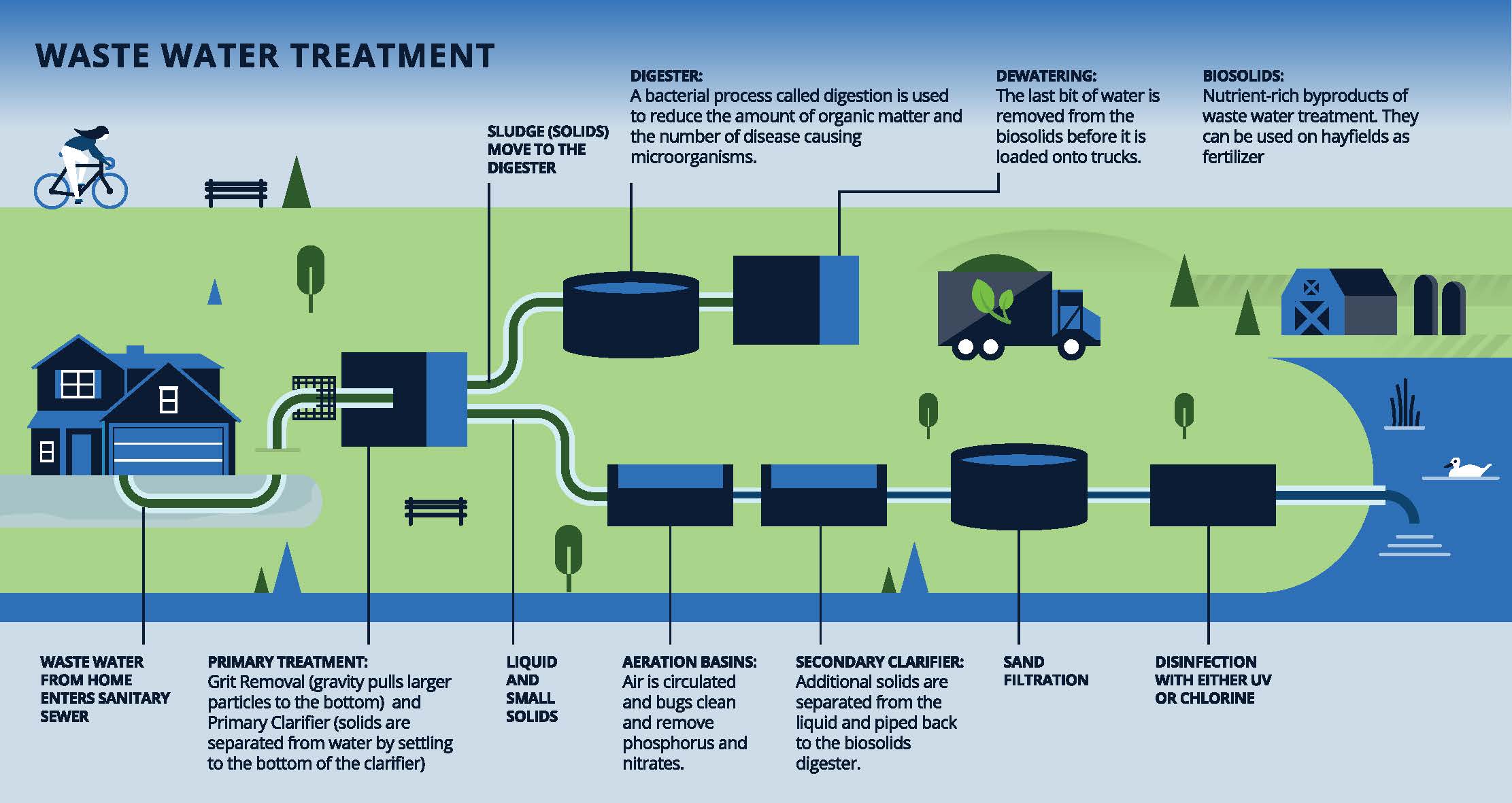
When you wash, brush, or flush, the water leaves your home and flows mostly by gravity down pipes to one of our wastewater treatment plants.

There are over 4,600 miles of pipe used to collect the wastewater in the collection system. Utility crews clean pipelines to prevent blockages and spills. They also clear blocked pipes, maintain pumping stations, repair damaged pipes, and connect new customers. Our plant operators work 24/7 to protect public health and the environment.

What is wastewater, and where does it go?

Used water (wastewater) from inside homes and businesses flow through thousands of miles of pipes to one of five wastewater treatment plants. The used water includes detergents, food, paper, and industrial & human waste. The collection system includes pipes, manholes, and pumping stations.

But how does it all work? Below is a quick explanation:

Pumping Influent

Wastewater flows by gravity from homes and businesses to the wastewater treatment plant. It enters the plant at a low elevation, usually near a creek. The wastewater is pumped uphill to begin treatment. Gravity moves water through the treatment process.

Preliminary Treatment

Screens remove large objects such as bottles,  branches, wipes, and trash. Grit chambers remove grit, sand, sediment, and gravel.

A big part of the wastewater treatment process is to separate the solids from the liquids and the liquids from the solids…

Liquids

Primary Treatment

Wastewater flows slowly through large tanks called primary clarifiers. This allows the heavier organic solids to settle down to the bottom of the tank. The settled material or primary sludge is pumped from the tank to a digester for further treatment.

Secondary (Biological) Treatment

Air bubbles are forced through the wastewater to encourage certain types of useful bacteria and microorganisms (microscopic single-cell organisms, think amoeba) to grow. These ‘bugs’ consume organic pollutants in the wastewater. They break pollutants (i.e. ammonia) into simpler forms (nitrates).

Final Clarification

The bacteria and microorganisms from the biological treatment phase are settled out of the wastewater in large tanks called final clarifiers. The bacteria/bugs are reused again in the treatment process…

Very similar to the primary clarifiers, the water moves slowly to allow the settling process to occur. Settled material or sludge that is pumped from the bottom of the clarifiers goes to digesters for further processing.

Filtration

Even though the wastewater flowing from the final clarifiers appears to be clear, there may be very tiny particles remaining. The flow is passed through a bed of sand or fine mesh screens called an effluent filter. This filter removes these particles.

Disinfection

The processed wastewater (effluent) is disinfected with ultraviolet (UV) light to neutralize any remaining harmful microorganisms.

Cascade Returns Water to Creek

The final stage of treatment is disinfection and then the water flows over a cascade of steps to the creek. The cascade steps looks and acts like a large waterfall putting oxygen from the atmosphere back to the water. The water may have a foam look as it travels down the creek due to the oxygen.

Solids

Digester

Digesters are large tanks where the solids removed from the clarifiers are heated, mixed, and treated with biological processes to remove harmful bacteria, break down fats and oils, and overall reduce the volume of solids. 

Biosolids

The solids removed from the digesters still contain a large amount of water. This water is removed for treatment. The treated biosolids are collected and returned to the environment. The biosolids are nutrient-rich byproducts of wastewater treatment. Biosolids are land applied on agricultural or farmers’ fields to as soil amendments and a source of fertilizer. 

Wastewater treatment operators and our laboratory professionals test both the water and solids throughout the process.

Did you know…

  1. Our oldest plants were built in the 1920s.
  2. Part of designing for treatment plants includes ensuring space for expansion for generations.
  3. Staff can take parts of the wastewater plant offline for cleaning, repairs, and upgrades all while treating the constant flow.

Additional resources:

What does a growing city mean to wastewater treatment plants?

Why does wastewater cost more than water on my bill?

How does CLTWater respond to a wastewater overflow?

Is the odor from a wastewater plant or sewer manhole?