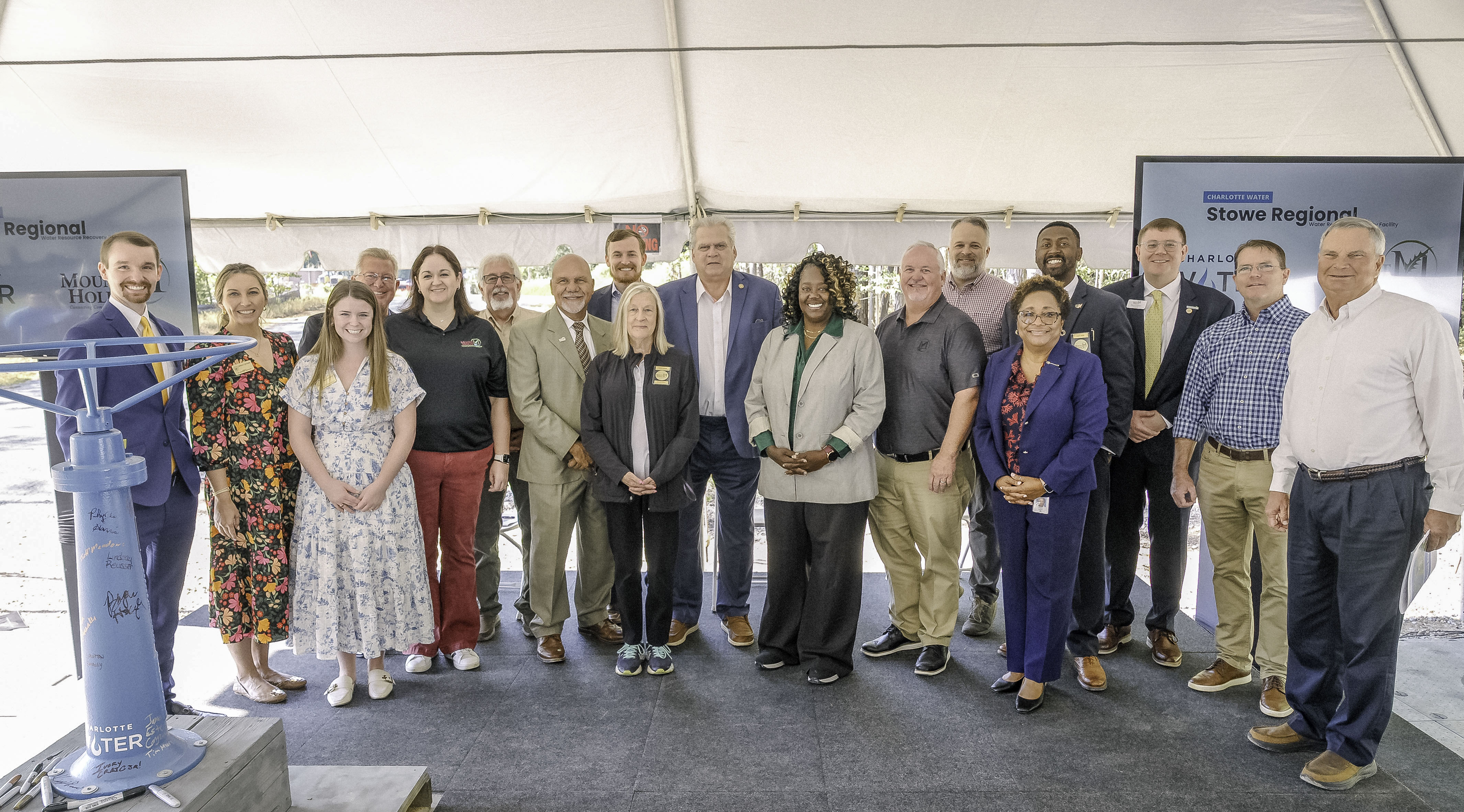
Charlotte Water and the City of Mount Holly celebrated the official commissioning of the Mount Holly Pump Station at Tuckaseege Park. This transformative moment reinforces our commitment to providing the best regional water infrastructure for our community.
Connecting Communities
This commissioning ceremony represents more than just flipping a switch; it’s the culmination of extensive regional collaboration and engineering innovation. The new pump station now connects Mount Holly’s wastewater system to Charlotte Water’s regional network through specially installed pipelines running approximately 65 feet beneath the Catawba River and Long Creek.
How It Works
Wastewater travels from Mount Holly homes and businesses to the new Mount Holly Pump Station
The station then pumps wastewater through underwater pipelines to Charlotte Water’s Long Creek Pump Station
From there, wastewater will be treated at existing Charlotte Water facilities
Partnership for the Future
This commissioning is a huge milestone in the larger Stowe Regional Water Resource Recovery Facility project. By transitioning Mount Holly’s wastewater service to Charlotte Water, we’re creating a more resilient and sustainable system that will protect water quality in the Catawba River while preparing our communities for future growth.
We extend our gratitude to everyone who joined us for this historic celebration. This achievement represents true connection across communities, demonstrating what’s possible when we work together to protect our water resources for generations to come.
Charlotte Water is once again providing reclaimed water to customers in the University Area, after a 10-year hiatus. Charlotte Water’s Mallard Creek Water Resource Recovery Facility (WRRF ) produces high-quality reclaimed water that is distributed to permitted users, who use the water for irrigation and cooling tower water. The reclaimed water system was constructed and placed into service in 1997 and provided permitted users with high quality reclaimed water until 2014. When the Mallard Creek WRRF experienced an illicit discharge of PCB’s (Polychlorinated Biphenyls) in 2014, the Reclaimed Water System was shut down to protect permitted user’s systems from potential contamination.
Following the illicit PCB discharge to the Mallard Creek WRRF, the facility underwent a lengthy decontamination process in order to ensure the facility was free of PCBs. After the decontamination process, the Mallard Creek WRRF was due for Improvements and Capacity Expansion, due to the growth in the University Area. As the Improvements and Capacity Expansion were nearing completion, discussions with previous and potential new reclaimed water users began, and a timeline was set for the Reclaimed Water System to be re-activated. The goal was to have the Reclaimed Water System back in service by the Summer of 2024.
The work to get the Reclaimed Water System back in service started in the early part of 2023. Charlotte Water’s Environmental Management Division (EMD) started discussions throughout the department to plan for restarting the Reclaimed Water System after being dormant for 10 years.The various groups within Charlotte Water that came together for this effort included; Field Operations, Engineering, Water Treatment, Maintenance, Backflow, Customer Service, IT, and Laboratory Services. This cross-functional team, with Leadership from Billy Allen (CLTWater’s Reclaimed Water System Coordinator), successfully conducted major required activities to get the system ready for operation once again.The major activities that needed to take place, included locating all valves and air release stations, exercising valves, testing backflow preventers, rebuilding air release stations, clearing right of ways, flushing of the reclaimed water pipelines with potable water, pressure testing the system with potable water, repairing two significant leaks, final flushing with reclaimed water, and sampling of the reclaimed water to ensure reclaimed water quality standards are being met.
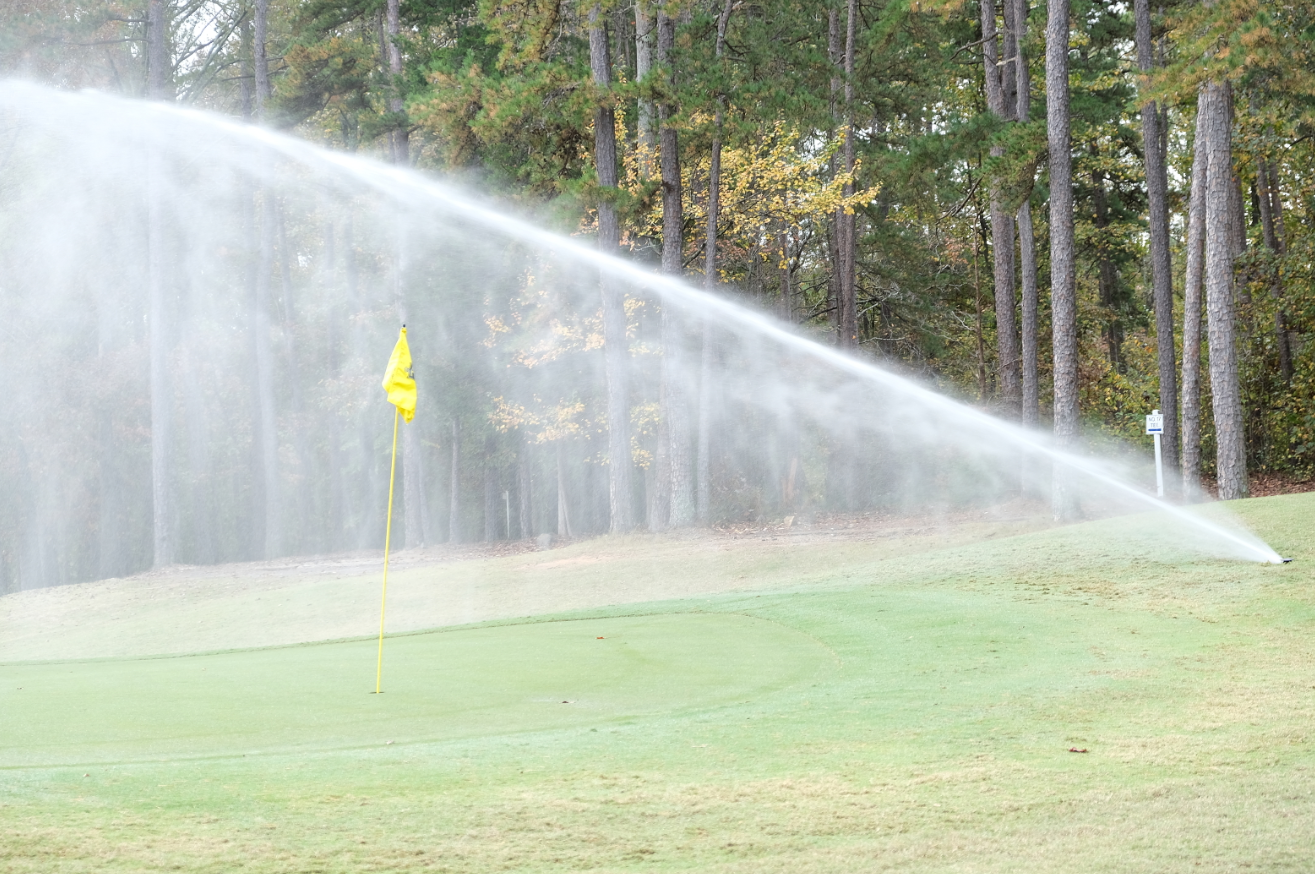
Once the hard work from this cross-functional team was complete, Charlotte Water was ready to place the Reclaimed Water System back into service for the first time in 10 years. On the morning of November 7th, a team from Charlotte Water’s EMD and Maintenance Divisions, completed the Switchover from Potable Water to Reclaimed Water, at The Tradition Golf Course, which Mecklenburg County owns. CLTWater EMD and Maintenance Division Staff accompanied Pinnacle Golf Staff (the contract golf course operator for Mecklenburg County) onto the course, to observe them restarting their irrigation system on reclaimed water and were able to confirm the successful transition back to reclaimed water, by seeing reclaimed water applied to the green on hole 16.
Currently, the only user that is actively receiving Reclaimed Water is The Tradition Golf Course, however the University of North Carolina Charlotte (UNCC) hopes to begin receiving and utilizing reclaimed water sometime in 2025. UNCC constructed a reclaimed water pipeline on their campus in 2022. CLTWater is also looking at ways to further expand the Reclaimed Water System in the University Area, as the use of reclaimed water offsets the use of potable water for irrigation and cooling tower water, as it reduces the impact on Charlotte Water’s Inter-Basin Transfer (IBT ) Certificate.
Many Charlotte Water Staff Members contributed greatly to this monumental effort, and everyone who participated should be extremely proud of this accomplishment! The Restarting of the Reclaimed Water System could not have happened without your hard work and dedication. A special recognition to the efforts of Rogers Brown, Corey Butler, Larry Davis, Don Rivers, and Shuhurah Lee, who all helped immensely with this effort in the field, during the past few months!
Lakeview Road is open! Charlotte Water (CLTWater) recently removed the closure and traffic measures along Statesville Road near Lakeview Road, as crews worked on a large water main opening along the roadway.
The work, related to the Water Transmission Mains Improvement & Repairs (WTMIR) Program, began Monday, July 24, and lasted a couple weeks. While traffic measures like detours and lane closures are sometimes frustrating, they are necessary for the safety of work crews and the public. In this case, the water main work happened parallel to other construction activities in the area. Thus, protecting people as well as the project was a priority.
Construction foreman removing cracked pieces of the pipe’s outer layer to assess the condition of the inner steel pipe.
Planning for any construction project while continuing to maintain access for nearby businesses, residents and motorists, can be complicated. It also takes a team effort. Before the project work begins, CLTWater collaborates closely with several different groups, such as state and city partners like NCDOT, CDOT, and other construction projects, to compare traffic plans and discuss ways to mitigate potential impacts as best as possible. This is all part of the important work CLTWater continues to do daily to provide clean, safe and reliable water across the Charlotte region.
Crew members are guiding the equipment operator on where to dump stone into the trench. While fixing the pipe, stone is added in the trench to combat the wet conditions.
Protecting and strengthening the CLTWater system is an important part of the daily work crews do. In the Fiscal Year 2024 budget, Charlotte Water designated millions of dollars towards the systemwide repairs and improvements, designed to update some of the oldest infrastructure throughout the system.
View of the existing pipe that is damaged. The wires pictured around the pipe are called “reinforcing steel wires.” They help keep the inner steel pipe from failing when there is pressure on the line. When the outside layer of mortar cracks over time, it allows the reinforcing steel wires to be exposed to the elements. After some time, the wires will begin to rust and break. This leaves the inner pipe without reinforcement and can eventually cause a line break.
In 2015, CLTWater completed a Water Transmission Mains Assessment, which evaluated some high-risk pipe composition across the water system that could need replacement. Transmission mains are the highways of water distribution; they are large pipes that convey water from pump stations or treatment plants to the neighbor distribution water lines. Since 2019, additional assessments identified various improvements needed to optimize the function and resiliency of the existing water transmission system.
The WTMIR Program is a combination of various replacement and installation projects across the water system, grouped under an umbrella of work designed to improve the water system. The Program is broken down into Zone Areas throughout the CLTWater service area. Each Zone Area will consist of various design and construction projects, which may or may not occur simultaneously.
When a pipe is damaged, workers will cut out the bad section and replace it with a stronger, more durable, pipe. The pipe pictured here is called Ductile Iron Pipe (or DIP). This is the finished replacement.
The importance of the WTMIR Program is to ensure water continues to flow to customers and reduces future emergency repairs that lead to unplanned water outages and traffic disruption.
Work has already been completed in several areas along Old Statesville Road, with upcoming work along Peachtree Rd, Oakdale Rd and other areas expected later this year.
Taken by Cam Coley, employee City of Charlotte, Charlotte Water
Charlotte is a rapidly growing city, in an equally rapidly expanding region. Investments in vital resources and infrastructure will not only support that growth but allow everyone to have a quality of life that is only capable through access to a safe, clean and reliable water system. Each of the 1,200 Charlotte Water system employees work hard to support that vision. Charlotte Water does this by increasing capacity through improvement and enhancement projects and by working 24/7/365 to maintain, repair and replace foundational infrastructure across the region.
Why are Water Rates Increasing?
Charlotte Water is legally required to operate as a “cost-of-service provider.” This means, as a utility, CLTWater must strictly use fees and rates to support, maintainand grow the water system. That requires us to operate as good water stewards and as a business operation that does not make a profit, but also can not legally operate at a loss.
Charlotte Water does not use property tax or sales tax to operate or fund capital improvements. The Charlotte Water system is supported entirely by water and sewer rates and fees paid by customers. Each dollar in rates has a specific purpose in how it goes to work in the water system. These rates allow Charlotte Water to:
Provide clean, safe and reliable drinking water
Maintain more than 9,000 miles of water and wastewater pipes
Rehabilitate, replace, and invest in aging infrastructure
Exceed regulatory requirements
Support regional growth
Safely transport and treat wastewater
To achieve this, each year, Charlotte Water systematically evaluates its existing infrastructure, upcoming capital needs (such as capacity), and other industry and economic variables. This helps determine if a rate adjustment is necessary. Potential adjustments are presented to the City Council, explaining how each dollar will be used and where it will go. If City Council approves, the new rates typically go into effect in July of that year. “FY,” or fiscal year, is identified as July of the current year into June of the following year.
For FY2024, (July 2023- June 2024) Charlotte Water rates will increase an average of 4.25% , which equals approximately a $3.10monthly increase for average Charlotte Water residential customer bills.
To learn more about the 2024 rates and fees, visit our webpage.
How are Rate Adjustments Decided/Calculated?
CLTWater uses a nationally-recognized rate consultant to evaluate and audit our rate model. This complex model uses many variables, such as regulatory, personnel, industry costs, etc., to create a ten-year projection.
Capital Improvement Plan
A large part of rates are used towards investing and funding Charlotte Water’s Capital Improvement Projects (CIP). Each year, CLTWater identifies and prioritizes several projects that are needed within a five-year period. Projects selected must meet certain requirements, such as fulfilling capacity needs, supporting future development, or improving the quality of life for the community.
The goal of the CIP is to:
Line up with CLTWater’s Mission and Vision to serve customers
Identify the right projects
Identify the funding needs
Maintain consistent annual funding levels
Ensure financial viability
Balance our goals against supporting municipal vision plans, economic development and regulatory requirements
For the fiscal year 2024-2028, CLTWater plans to invest $2.63 Billionback into the community’s utility. The investment can be broken down into key groups:
Capacity for Growth $1.5B to expand and upsize pipes and plants to maintain service for a growing community
Rehab and Replacement $645M to replace some of the oldest infrastructure
Regulatory Requirements $279M to complete projects related to new state or federal regulations
Commitments to Public Projects $115M to relocate pipes before NCDOT, City of Charlotte, or town-funded projects
Utility Support $70M towards advancement in technology, security and updates to current facilities
FY 24 Industrial Sewer Rates
CLTWater recently worked with a utility consulting firm to complete a rate study and better understand our rates and cost of treatment. During the evaluation, we learned some of the industrial sewer rates had not been updated since 2011. This meant a rate recovery was needed for:
increased costs of treatment
treatment plant improvements
operational costs and program costs
Industrial Fees are different than regular customer sewer rates because industries usually have different/stronger compositions of certain chemicals. Treatment plants are designed and regulated for domestic (residential) strength wastewater.
Each industry/business is unique in its usage and discharge. For most commercial and utility users, your bill is calculated based on how much water you use and your wastewater composition. In general, the more you use, the more you pay. For monitored industries, the higher the concentration of chemical oxygen demand (COD), total suspended solids (TSS) or ammonia discharged, the more you will pay.
Non-monitored industries, e.g., breweries and restaurants, incur the high strength volume charge.
To mitigate the impact of the rate recovery, rates are proposed to increase in three phases:
July 1, 2023
January 1, 2024
Incremental increases annually expected to start July 1, 2024
To learn more about the different industrial and commercial rates, view these one-pagers below.
Charlotte Water Cares
CLTWater is always looking for ways to connect customers to resources and available financial aid programs. We work closely with several community partners, including Crisis Assistance and the Department of Social Services, to connect residents to resources. Learn more about our “Dream Team” by reading our blog article.
Financial assistance is available for families in need. Charlotte Water encourages customers to contact 3-1-1 or visit charlottewater.org to learn more about the many financial assistance programs available.
A conversation with Charlotte Water
document.addEventListener('DOMContentLoaded', function () {
const observer = new MutationObserver(() => {
document.querySelectorAll('.jetpack-instant-search__search-result-expanded__image').forEach(img => {
if (!img.hasAttribute('alt')) {
img.setAttribute('alt', '');
}
});
});
observer.observe(document.body, {
childList: true,
subtree: true
});
});