Tag Archives: Wastewater

Charlotte Water is Back in the Reclaimed Water Business!!!

Charlotte Water is once again providing reclaimed water to customers in the University Area, after a 10-year hiatus.  Charlotte Water’s Mallard Creek Water Resource Recovery Facility (WRRF ) produces high-quality reclaimed water that is distributed to permitted users, who use the water for irrigation and cooling tower water.  The reclaimed water system was constructed and placed into service in 1997 and provided permitted users with high quality reclaimed water until 2014.  When the Mallard Creek WRRF experienced an illicit discharge of PCB’s (Polychlorinated Biphenyls) in 2014, the Reclaimed Water System was shut down to protect permitted user’s systems from potential contamination.

Following the illicit PCB discharge to the Mallard Creek WRRF, the facility underwent a lengthy decontamination process in order to ensure the facility was free of PCBs.  After the decontamination process, the Mallard Creek WRRF was due for  Improvements and Capacity Expansion, due to the growth in the University Area. As the Improvements and Capacity Expansion were nearing completion, discussions with previous and potential new reclaimed water users began, and a timeline was set for the Reclaimed Water System to be re-activated.  The goal was to have the Reclaimed Water System back in service by the Summer of 2024.

The work to get the Reclaimed Water System back in service started in the early part of 2023.  Charlotte Water’s Environmental Management Division (EMD) started discussions throughout the department to plan for restarting the Reclaimed Water System after being dormant for 10 years.The various groups within Charlotte Water that came together for this effort included; Field Operations, Engineering, Water Treatment, Maintenance, Backflow, Customer Service, IT, and Laboratory Services.  This cross-functional team, with Leadership from Billy Allen (CLTWater’s Reclaimed Water System Coordinator), successfully conducted major required activities to get the system ready for operation once again.The major activities that needed to take place, included locating all valves and air release stations, exercising valves, testing backflow preventers, rebuilding air release stations, clearing right of ways, flushing of the reclaimed water pipelines with potable water, pressure testing the system with potable water, repairing two significant leaks, final flushing with reclaimed water, and sampling of the reclaimed water to ensure reclaimed water quality standards are being met.

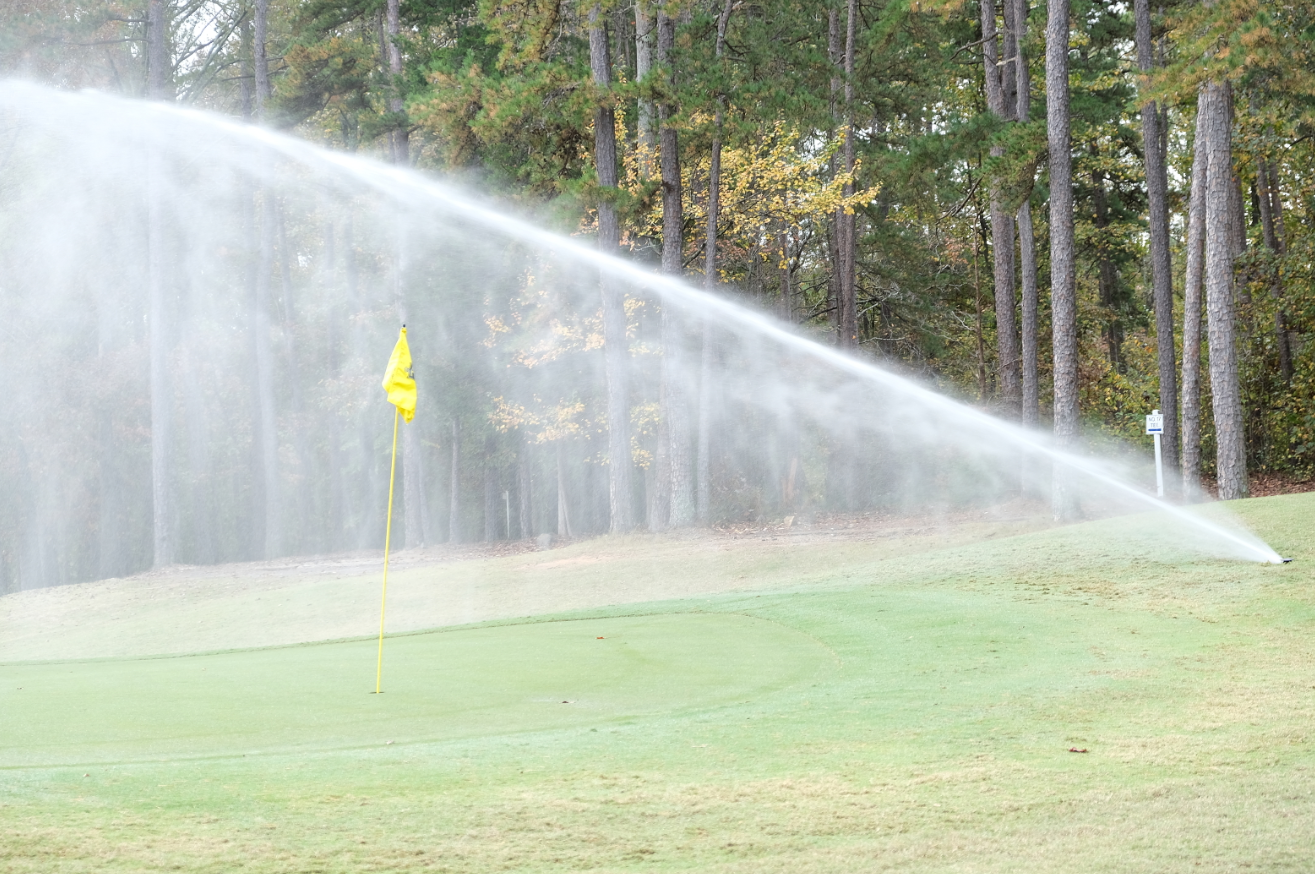
Once the hard work from this cross-functional team was complete, Charlotte Water was ready to place the Reclaimed Water System back into service for the first time in 10 years.  On the morning of November 7th, a team from Charlotte Water’s EMD and Maintenance Divisions, completed the Switchover from Potable Water to Reclaimed Water, at The Tradition Golf Course, which Mecklenburg County owns.  CLTWater EMD and Maintenance Division Staff accompanied Pinnacle Golf Staff (the contract golf course operator for Mecklenburg County) onto the course, to observe them restarting their irrigation system on reclaimed water and were able to confirm the successful transition back to reclaimed water, by seeing reclaimed water applied to the green on hole 16.

Currently, the only user that is actively receiving Reclaimed Water is The Tradition Golf Course, however the University of North Carolina Charlotte (UNCC) hopes to begin receiving and utilizing reclaimed water sometime in 2025.  UNCC constructed a  reclaimed water pipeline on their campus in 2022.  CLTWater is also looking at ways to further expand the Reclaimed Water System in the University Area, as the use of reclaimed water offsets the use of potable water for irrigation and cooling tower water, as it reduces the impact on Charlotte Water’s Inter-Basin Transfer (IBT ) Certificate.

Many Charlotte Water Staff Members contributed greatly to this monumental effort, and everyone who participated should be extremely proud of this accomplishment!  The Restarting of the Reclaimed Water System could not have happened without your hard work and dedication.  A special recognition to the efforts of Rogers Brown, Corey Butler, Larry Davis, Don Rivers, and Shuhurah Lee, who all helped immensely with this effort in the field, during the past few months!

Sweet Success: Charlotte Water Wins First Prize in Honey Tasting Contest

The Mecklenburg Beekeepers Association hosted its annual honey-tasting contest in early October.  Beekeepers from all over the county were invited to submit honey samples for judging based on taste.  This year, 29 jars were submitted and tasted by more than 40 judges from the beekeeping community and the public.

Using a double-blind taste test and a 3-round elimination bracket, the best-tasting honey selected was a mixture including nectar sources from the McAlpine Creek Wastewater Treatment Plant (WWTP) and the Irwin Creek WWTP.  McAlpine Creek WWTP has approximately eight hives, and Irwin Creek WWTP has three hives, managed by Charlotte Water staff. 

In addition to the Charlotte Water managed hives, Irwin Creek WWTP also has four hives managed by an external partner and the McDowell Creek WWTP has two hives. 

The quality of the honey the hives produce at the wastewater treatment plants is a testament to everything these facilities stand for… clean water for a clean environment.  Not only do the Charlotte Water treatment plants specifically create clean water, but their large footprints host a tremendous amount of plant and animal diversity.  There seems to be something in bloom at treatment plants, and the bees know it.

The wide range of plants and closed-off nature of the treatment facilities create an oasis for urban wildlife, with all manner of birds, mammals, and insects left to thrive relatively close to the city.

As part of winning the best-tasting honey in Mecklenburg County, the Charlotte Water honey will be sent to a lab for pollen grain analysis to better understand the sources of nectar our bees love so much!

Beehive

A Cheaper Sugar for Sweet Tooth Bugs (Substitute for Acetic Acid)

Since 2001, sugar water has been used at the McDowell plant as an acetic acid substitute.

McDowell Creek Wastewater Treatment Plant is one of the most technologically advanced in removing nutrients and enhancing downstream water quality. Sustainable innovations are nothing new to operators. Since 2001, sugar water has been used at the McDowell plant as an acetic acid substitute. It’s a win-win for Charlotte Water and local businesses when both save money by reusing a waste product.

Sugar water is produced when the soft drink manufacturers have expired or out-of-date products that they have pulled from store shelves and need to dispose of it. It is also produced when the manufacturers make a bad batch of cola and/or need to wash down the processing equipment. This sugar water is used as an organic carbon food source for microorganisms (bugs) that remove phosphorous and nitrogen during the wastewater treatment process. Because McDowell’s effluent discharges into a nutrient-sensitive creek, operators use advanced treatment techniques to also remove nutrients, nitrogen, and phosphorous from water.

The sugar water is a safe, cheap alternative that significantly reduces the use of acetic acid in the treatment process, reducing resource consumption and making use of waste that would otherwise need to be disposed of. The soft drink manufacturer gives it to CLTWater for free and CLTWater pays for the shipping. The process saves ratepayers hundreds of thousands of dollars each year.

Learn more at

Wastewater treatment plant process

Wastewater Performance Reports

A Foul Odor Outside May or May Not Be Wastewater

Have you ever ventured outside and something quite astonishing assaulted your nose? It may be easy to pin the blame on a wastewater treatment plant that could be nearby. However, foul odors commonly emanate from a variety of sources in our community:

  • Landfills
  • Industries (i.e. paper or chemical plants)
  • Natural gas pipeline work
  • A wastewater spill
  • Wastewater plants
  • Even private plumbing

Let’s start inside the home…


Private plumbing systems are designed to prevent wastewater gases from entering residences. All active sewer lines contain gases, and a malfunctioning plumbing system could allow gases or odors to enter the home.

Is the odor inside?

Is the odor only coming from…:

A drain that hasn’t been used recently?

We recommend for you to pour a gallon of water down the drain and see if the odor persists.

Multiple drains that are used frequently?

It may be a blockage or clog in your plumbing. Try a liquid dissolvent, please follow directions and see if this clears the clog and dissipates the odor.

A kitchen sink?

Clean the disposal (following the owner’s manual).

What you put down the drain (grease, oils, wipes) can cause odors clogging your plumbing. If the odor does not go away and is only inside your house, consider having a licensed plumber check your plumbing and vent system.

illustration of sink showing that water sits in the trap keeping gases and odors from coming out of the drain. Houses have a vent to the room so that any odor will escape outside.

Odor Outside Home?

Every home has a wastewater vent (on the roof) that could be the source of an odor immediately outside your home (patio, deck, etc.). The odor could be caused by a clog or blockage in your plumbing. Check with neighbors to see if they are also experiencing the odor. If it is only noticed just outside your building, contact a plumber.

Another place to check is in your front yard. Most homes also have a white plastic lid called a cleanout, and that if not closed properly it may cause odor in the yard.

If you live on waterfront property or the road is higher than your house, you may have a low-pressure sanitary sewer system to pump your wastewater up to the gravity fed sewer system. It is possible that this system may be causing an odor in the pump basin if something is malfunctioning.

What Can Cause A Wastewater Type Odor?

Sewage odor may be a sign of a nearby wastewater overflow that needs immediate attention.

​If you see or suspect a wastewater overflow or spill, call 311 or 704-336-7600 – 24 hours a day, seven days a week. If calling after hours, please say or select ‘wastewater emergency’ to speak to our dispatchers.

If you live beside a wastewater treatment plant, there may be some occasions when a smell is noticeable outside the property. Wastewater odor can be noticeable during warm temperatures, buildup of debris in pipes, or low flow during some nights and weekends.

CLTWater Takes Odor Seriously

For decades, wastewater treatment plants that were once neighbors to farms and forests are now neighbors to residential neighborhoods and businesses. In fact, there’s a wastewater treatment plant in the Little Sugar Creek / South Park area! As people moved closer to our plants, CLTWater invested millions on odor reduction. We aren’t baking bread, but we try hard to make the treatment of our community’s wastewater less noticeable.

Air scrubbers, carbon filters, bio-filters, help CLTWater reduce odors that can occur during the wastewater treatment process. We are committed to safely treating wastewater and reducing odors. We appreciate your input to help us identify potential odors.

How Do I Report an Odor or Sewer Spill?

If you see or suspect a wastewater overflow, call 311 – 24 hours a day, seven days a week (say or select wastewater emergency).

  • Try to locate the source.
  • If it is coming from a manhole or a creek, call 311 or 704-336-7600 and provide the closest address.
  • A repair crew will respond quickly, investigate the cause and repair any publicly owned pipes, if needed.

Links